
- Dawei Metal 2026 Chinese New Year Special Offer: Gallop into Success with Upgraded Tools!
- Aluminum Alloy Combination Tool Set for Home, Automotive, and Repair Use
- Striking Tools: Types, Uses, and How to Choose the Right One
- Highest Quality Hand Tools: Inside the World's Most Trusted Tool Brands
- Why a Machete Saw Belongs in Your Outdoor Kit
Company:Shandong Dawei Metal Materials Co., Ltd.
Tel:+8615666285386
Email:dwhardwaretools@gmail.com
Address:Room 1413, Building 8, Shandong Steel Xintiandi Plaza, No. 61 Gongye South Road, High-tech Zone, Jinan City
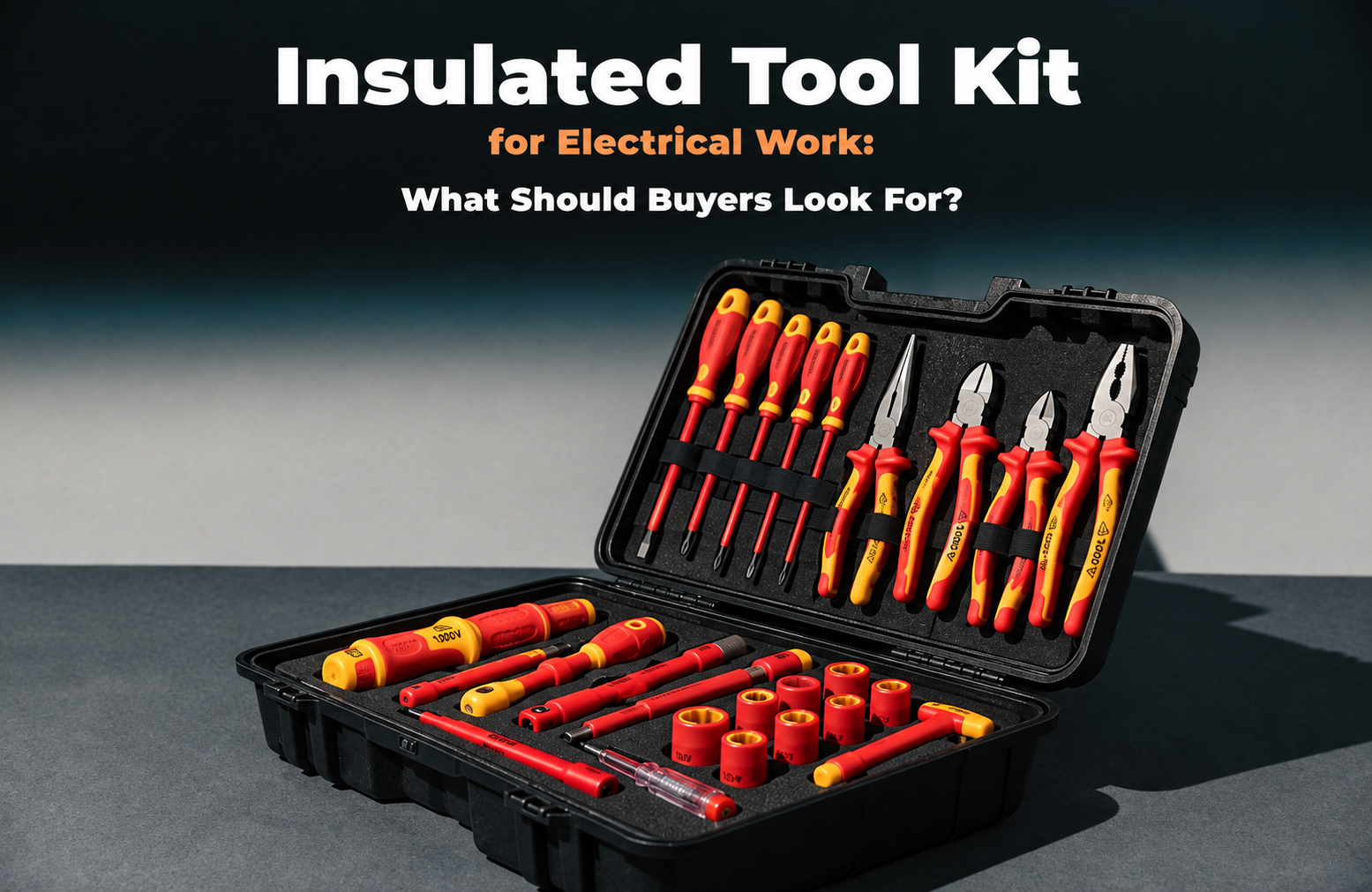
Insulated Tool Kit for Electrical Work: What Should Buyers Look For?
An insulated tool kit is an essential part of an electrician's equipment. It usually combines insulated screwdrivers, pliers, wire strippers, cutters, and other hand tools used for electrical installation and maintenance.
However, not every electrician needs the same configuration. A basic maintenance kit may cover screwdriver and wiring tasks, while industrial electrical maintenance often requires insulated wrenches, sockets, and additional accessories.
For wholesalers and importers, choosing an insulated tool kit involves more than comparing piece counts. Tool specifications, insulation markings, certification documents, storage cases, and production consistency all deserve attention.
This guide explains what to look for when sourcing electrical insulated tools for professional use and wholesale distribution.
1. What Are Insulated Tools for Electrical Work?
Insulated tools are hand tools designed with protective insulating material around their working handles or other specified areas.
They are intended to help reduce the risk of accidental electrical contact when used correctly and within their certified voltage limits.
Common electrical insulated tools include:
Insulated screwdrivers
Insulated combination pliers
Insulated needle-nose pliers
Insulated diagonal cutters
Insulated wire strippers
Insulated cable cutters
Insulated wrenches and sockets
A common mistake is assuming that any screwdriver with a red or yellow plastic handle is an electrical safety tool.
That is not sufficient. A certified insulated tool must meet the applicable requirements and carry verifiable markings and documentation.
For professional purchasing, buyers should pay particular attention to IEC 60900 and the actual certification status of each tool.
2. What Standard Should Insulated Tools Meet?
IEC 60900:2018 is an international standard covering insulated, insulating, and hybrid hand tools for work up to 1,000V AC and 1,500V DC.
The standard addresses the design and testing requirements of these tools. The applicable edition and certification documentation should be checked before making product compliance claims.
Reference: IEC 60900:2018 – International Electrotechnical Commission.
IEC 60900 vs VDE: What's the Difference?
These two terms are often used together, but they do not mean exactly the same thing.
| Item | Meaning | What buyers should check |
| IEC 60900 | International standard for insulated hand tools | Applicable edition and compliance documentation |
| VDE | Certification and testing mark associated with VDE | Authentic certification and model coverage |
| 1000V AC | Common rated working voltage marking | Whether the specific tool carries valid supporting documentation |
| Double triangle | Symbol associated with suitability for live working | Correct marking on the individual tool |
Do not judge an insulated tool by its appearance.
Ask the supplier for the applicable certificate, test report, product model, and manufacturing traceability. A general company certificate does not automatically prove that every insulated tool in a catalogue is certified.
Also distinguish the tool's rated working voltage from the electrical test voltage used during testing. They are not interchangeable figures.
Safety note: Insulated tools do not replace circuit isolation, lockout/tagout, voltage verification, appropriate PPE, or electrician training. Electrical work should follow the applicable safety procedures and be performed by qualified personnel.
3. What Should a Complete Insulated Tool Kit Include?
The right assortment depends on the electrical work being performed.
For general installation and maintenance, the following tools provide a useful starting point.
| Tool | Main application | Important specification |
| Slotted screwdrivers | Terminal connections and electrical panels | Blade width and shaft length |
| Phillips screwdrivers | Switches, covers, and electrical equipment | PH size and tip fit |
| Combination pliers | Gripping and bending conductors | Jaw alignment and cutting capacity |
| Needle-nose pliers | Reaching confined areas | Jaw length and insulation |
| Diagonal cutters | Cutting suitable conductors | Rated cutting capacity |
| Wire strippers | Removing cable insulation | Supported wire cross-section |
| Cable cutters | Cutting larger cables | Cable diameter and cutting capacity |
| Insulated wrenches | Electrical equipment fasteners | Metric sizes and head design |
| Insulated sockets and ratchet | Recessed bolts and industrial maintenance | Drive size and socket range |
For industrial maintenance, wrenches and sockets are particularly useful when working with motor terminal boxes, switchboards, and equipment fasteners.
A voltage tester may also be supplied as an accessory. However, its instrument type and electrical rating must be verified separately. A simple non-contact voltage pen should not be treated as a substitute for an appropriate voltage tester when proving a circuit is de-energized.
4. How to Choose Between Different Insulated Tool Kits
Piece count is useful when comparing products, but it does not tell the whole story.
A 15-piece set may provide better coverage for basic electrician work than a larger kit containing accessories that your customers rarely use.
For wholesalers, it is better to compare the actual tool configuration.
Basic Insulated Tool Kit
A compact set is suitable for customers who mainly need screwdrivers, pliers, wire strippers, and cutters.
For example, Dawei's WEIDA W07315 configuration includes:
Insulated combination and long-nose pliers
Diagonal cutters and wire stripper
Cable cutter
Phillips screwdrivers
Five slotted screwdrivers
Voltage tester pen
Portable storage case
Product reference: WEIDA W07315 Insulated Electrician Tool Set.
Insulated Wrench and Screwdriver Set
For maintenance technicians working with electrical equipment fasteners, additional wrench sizes can make the kit more practical.
The WEIDA W07317 includes insulated pliers, screwdrivers, wire-stripping tools, an adjustable wrench, and five fixed insulated wrenches in 10, 12, 14, 17, and 19mm sizes.
Product reference: WEIDA W07317 Insulated Electrician Tool Set.
Industrial Insulated Maintenance Set
Industrial maintenance often involves different fasteners and cable sizes.
The WEIDA W07318 configuration includes:
Insulated open-end wrenches
Insulated box-end wrenches
Adjustable wrench
Combination and long-nose pliers
Diagonal cutters and cable cutter
Phillips and slotted screwdrivers
Wire stripper and other accessories
The listed wrench sizes include 10, 14, and 19mm box-end wrenches, plus 10, 14, and 17mm open-end wrenches.
Product reference: WEIDA W07318 19-Piece Electrician's Tool Set.
Insulated Socket Tool Kit
When electrical maintenance involves recessed fasteners, an insulated socket system can be more convenient than relying entirely on open-end wrenches.
Dawei's WEIDA W07325 configuration features a 1/2-inch drive insulated socket system, including 14 listed socket sizes from 10mm to 32mm, an insulated ratchet, extension bars, screwdrivers, pliers, and an adjustable wrench.
Product reference: WEIDA W07325 Insulated Socket Tool Set.
Product Configuration Comparison
| Model | Main configuration | Suitable purchasing direction |
| W07315 | Screwdrivers, pliers and wire tools | Basic electrician kits |
| W07317 | Screwdrivers, pliers and fixed wrenches | General electrical maintenance |
| W07318 | Open-end and box-end wrenches, cutters and screwdrivers | Industrial maintenance |
| W07325 | 1/2-inch insulated sockets, ratchet and accessories | Applications requiring socket coverage |
The listed product titles and configurations should be checked against the final bill of materials and packing list. In particular, confirm the exact piece count and certification documents for the version being ordered.
5. How to Check Insulated Tool Quality Before Bulk Ordering
For electrical insulated tools, quality inspection needs to cover both mechanical performance and the insulating system.
A tool may turn a screw properly while still having a defect in its insulation. These are separate inspection requirements.
Insulation Inspection
Check for:
Cracks, cuts, and punctures.
Loose or separated insulation.
Exposed metal in protected areas.
Uneven coating or molding defects.
Damaged finger guards.
Missing or unclear markings.
The insulating material should remain properly attached to the tool and match the approved product specification.
Working-End Inspection
The metal part must also perform its intended function.
Check screwdriver tip dimensions, plier jaw alignment, cutting-edge condition, wrench dimensions, and socket engagement.
Poorly fitting tools can slip or damage fasteners, creating additional risks in electrical maintenance work.
Documentation and Pre-Shipment Inspection
For a wholesale order, ask the supplier to provide documentation relevant to the actual product models.
| Inspection item | What to verify |
| Certification | Valid documents covering the actual model |
| Voltage marking | Correct marking and rating |
| Standard | Applicable IEC 60900 requirements |
| Insulation | No visible damage or separation |
| Mechanical function | Working ends meet agreed specifications |
| Product markings | Manufacturer, model, and other required identification |
| Packing list | Every tool and accessory matches the order |
| Export packaging | Proper protection and carton information |
Ask whether electrical tests are performed on individual tools, samples, or production batches. Request the corresponding records rather than assuming a particular testing arrangement.
For more information about daily inspection and maintenance, see Dawei's related guide: How to Maintain and Store Insulated Tools.
6. What Should Importers Consider When Buying Insulated Tools Wholesale?
For distributors and electrical equipment suppliers, sourcing decisions should include product configuration, customization, packaging, and long-term supply arrangements.
Before requesting a quotation, prepare the following details:
| Purchasing requirement | Information to confirm |
| Tool configuration | Required tools and sizes |
| Insulation rating | Required voltage class |
| Certification | IEC 60900 or other applicable requirements |
| Quantity | Estimated quantity per model |
| Logo | Brand marking requirements |
| Packaging | Plastic case, molded case, or customized packaging |
| Inspection | Agreed testing and acceptance criteria |
| Spare parts | Replacement tool availability |
For private-label orders, customization may include logo printing, handle color, product assortment, case layout, and retail packaging.
MOQ and lead time depend on the specific configuration and customization requirements. Confirm these details before approving mass production.
Explore Dawei Metal's wholesale tool sets and OEM/ODM services for more information.
Frequently Asked Questions
1. What is included in an insulated tool kit?
A typical electrician's tool kit includes insulated screwdrivers, combination pliers, needle-nose pliers, diagonal cutters, and wire strippers. Larger sets may also include insulated wrenches, sockets, ratchets, and cable cutters.
2. What voltage rating should insulated tools have?
Many professional insulated hand tools are designed for use up to 1000V AC and 1500V DC under IEC 60900. The actual rating must be confirmed through the individual tool markings and applicable certification documents.
3. Are all red and yellow electrical tools VDE certified?
No. Handle color alone does not establish certification. Buyers should verify the manufacturer's identification, model markings, certification scope, and supporting documents.
4. What is the difference between an insulated tool kit and a regular tool kit?
An insulated tool kit is designed with protective insulating components and is manufactured and tested against applicable electrical tool requirements. An ordinary tool kit may have plastic or rubber handles but does not automatically provide certified electrical protection.
5. Can insulated tools be customized for wholesale orders?
Depending on the model, OEM options may include logo marking, handle colors, tool assortment, case design, and retail packaging. Certification requirements and MOQ should be confirmed separately for each configuration.
Conclusion
Choosing an insulated tool kit for electrical work requires more than counting the tools inside a case.
The right configuration should match the electrician's daily tasks, provide the required screwdriver and plier sizes, and include the appropriate wrenches or sockets when industrial maintenance is involved.
For B2B buyers, certification verification, product inspection, packaging, and production consistency are equally important.
Looking for an insulated tool kit manufacturer for wholesale or OEM orders?
Contact Dawei Metal with your preferred tool configuration, voltage requirements, estimated quantity, and branding details to discuss a suitable electrical insulated tool set.
-
Insulated Tool Kit for Electrical Work: What Should Buyers Look For?
-
How to Choose Pruning Shears: Types, Materials & Buying Guide
-
Garden Tools for Home, Orchard & Landscaping: How to Choose the Right Tools
-
Screwdriver Sets: The Steel, the Tip Geometry, and the Sourcing Mistakes That Fill Your Returns Bin
-
Rolling Tool Chest with Tools: How to Choose the Right Setup for Your Workshop
-
Insulated Pliers vs. Regular Pliers: What Is the Difference?