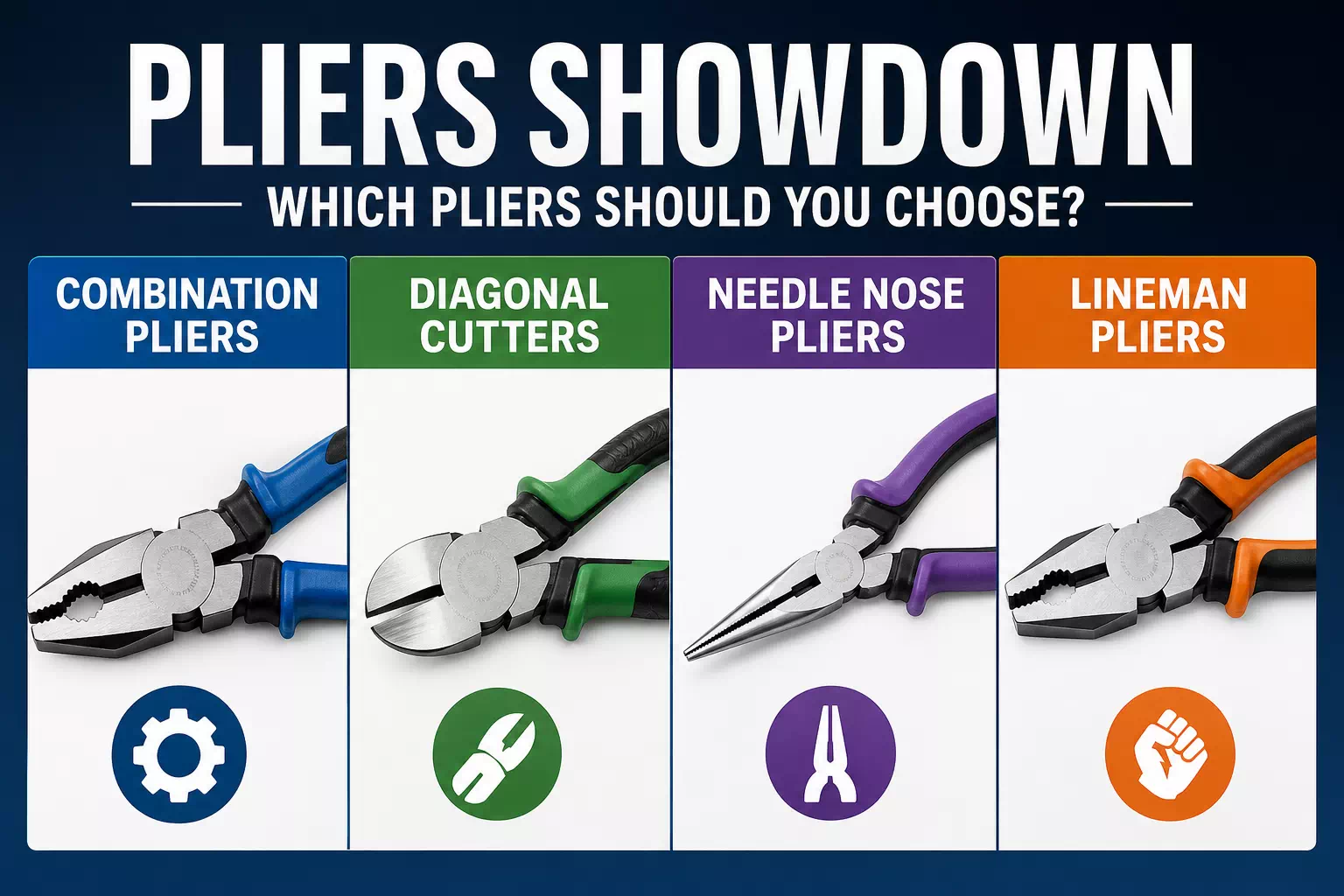
Combination pliers, diagonal cutters, needle nose pliers, and lineman pliers may look similar at first glance, but each tool is designed for a different type of work. Choosing the right pair affects grip, cutting accuracy, access to confined spaces, and the service life of the tool.
For electricians, mechanics, maintenance teams, hardware distributors, and professional tool buyers, understanding these differences helps prevent tool misuse and makes product selection more straightforward. This guide compares the four types, explains their practical applications, and covers the specifications worth checking when sourcing pliers for professional use.
Dawei Metal supplies a range of pliers and hand tools, including combination pliers, diagonal cutting pliers, and needle nose pliers, with product options for workshops, electrical maintenance, and general repair applications.
Quick Answer: Which Type of Pliers Do You Need?
| Tool Type | Main Function | Best Applications |
|---|---|---|
| Combination Pliers | General gripping, bending, holding, and limited wire cutting | Workshop maintenance, household repairs, and general electrical work |
| Diagonal Cutters | Cutting wire and trimming small projecting components | Electrical wiring, electronics, assembly, and cable-tie trimming |
| Needle Nose Pliers | Reaching, gripping, and shaping small components in confined spaces | Electrical panels, electronics repair, precision assembly, and wire forming |
| Lineman Pliers | Heavy-duty gripping, twisting, and cutting within the tool's rated capacity | Electrical installation, wire handling, and utility maintenance |
Buying tip: Combination pliers are a practical general-purpose choice. Diagonal cutters are better for dedicated cutting tasks, needle nose pliers provide reach and control, and lineman pliers are designed for jobs that require stronger gripping and wire-handling capability.
1. Combination Pliers: A Versatile Workshop Essential
Combination pliers are designed to perform several basic operations with one tool. Depending on the jaw design, they can grip flat or rounded components, bend wire, hold small parts, and cut suitable wire using the integrated cutting edges.
This versatility makes them useful for maintenance teams, automotive workshops, assembly operations, and general repair work. A technician working on a loose bracket, a small metal component, or a wire connection can often complete several handling tasks without changing tools.
Common Applications
Gripping and holding small metal components.
Bending wire and adjusting workpieces during assembly.
Pulling and positioning suitable wires.
Cutting wire within the tool's rated capacity.
General workshop and household maintenance.
What Should Buyers Check?
The gripping jaws should align properly when closed, and the pivot should move smoothly without excessive side play. The cutting edges should meet consistently, while the handles should provide enough room for a secure grip.
Material and heat treatment also matter. Dawei's A-Type Combination Pliers with Dolphin Handle are made from high-carbon steel and feature induction-hardened cutting edges and double-injection handles. Listed sizes are 6, 7, and 8 inches, giving distributors options for different market requirements.
For buyers comparing handle styles and finishes, Dawei also lists B-Type Nickel-Plated Combination Pliers in 6-, 7-, and 8-inch sizes.
2. Diagonal Cutters: Built for Controlled Cutting
Diagonal cutters, also called diagonal cutting pliers or side cutters, have angled cutting edges that let the user approach a wire from the side. Their head geometry makes them particularly useful when a clean, controlled cut is more important than gripping or twisting.
Unlike combination pliers, diagonal cutters are primarily cutting tools. They are commonly used for trimming electrical wire, cutting suitable small conductors, and removing projecting cable-tie ends during assembly.
Where Diagonal Cutters Work Best
Trimming copper wire within the tool's rated capacity.
Cutting small leads during electronics assembly.
Removing excess cable-tie tails.
Trimming suitable soft wire during maintenance.
Working where a bulky combination-plier head would be inconvenient.
Cutting Edge Quality and Capacity
For professional users, a sharp edge is only part of the specification. The cutting edges need to meet correctly, the joint should remain stable, and the tool must be matched to the material being cut.
Forcing diagonal cutters through oversized conductors, hardened steel wire, or other materials outside their rated capacity can chip the edges or damage the joint. Use a dedicated cable cutter or another appropriately rated tool when the job requires it.
Dawei's A-Type Diagonal Cutting Pliers feature a high-carbon steel body, a polished finish, induction-hardened cutting edges, and a double-injection handle. The listed model is 6 inches long.
An alternative is the B-Type Nickel-Plated Diagonal Cutting Pliers, which use a nickel-plated finish and dual-color handles. Buyers should compare the required size, finish, cutting capacity, and handle configuration before placing a bulk order.
3. Needle Nose Pliers: Precision in Tight Spaces
Needle nose pliers, also known as long nose pliers, have long, narrow jaws that reach into spaces where wider pliers cannot work comfortably. They are designed to give the user control when positioning small parts or shaping wire.
In electrical control cabinets, electronics assembly, and equipment maintenance, access can be as important as gripping force. Long nose pliers help technicians hold a small connector, guide a wire around an obstruction, or retrieve a component from a confined location.
Typical Applications
Positioning wires inside crowded enclosures.
Holding small components during assembly.
Bending and forming wire ends.
Handling small parts during electronics repair.
Reaching into narrow gaps around mechanical assemblies.
How to Choose the Right Length
Shorter needle nose pliers are generally easier to control in compact work areas. Longer models offer additional reach but may provide less convenient access when the surrounding components leave little room for the handle.
Check the tip alignment and closing action before selecting a model. The jaws should meet consistently near the tip, particularly when the intended task involves small wires or components. If cutting edges are integrated into the design, verify their intended cutting capacity separately.
Dawei offers A-Type Needle Nose Pliers with Dolphin Handle in 6- and 8-inch sizes. The product page specifies high-carbon steel construction, a polished rust-resistant finish, induction-hardened cutting edges, and a double-injection handle.
For buyers who prefer a different surface finish, the B-Type Nickel-Plated Needle Nose Pliers are listed in 6- and 8-inch sizes.
4. Lineman Pliers: For Heavy-Duty Wire Handling
Lineman pliers, often called linesman pliers, are commonly used in electrical installation and utility work. Their design typically combines strong gripping jaws with cutting edges and a pivot geometry suited to demanding wire-handling tasks.
Compared with slim needle nose pliers, lineman pliers generally have a wider, more substantial head. That makes them useful for holding, twisting, and manipulating suitable wires when a precision tip would not provide enough contact area.
Common Uses
Gripping and twisting suitable conductors during installation.
Holding wire securely while making mechanical adjustments.
Cutting compatible wire within the manufacturer's stated capacity.
General electrical installation and maintenance tasks.
Lineman Pliers vs. Combination Pliers
The two types can overlap in general-purpose work, but they should not automatically be treated as identical. Their jaw profiles, leverage, head geometry, and cutting capacities vary by model and manufacturer.
When sourcing lineman pliers, check the jaw shape, pivot construction, handle design, and specified cutting capacity. If the product is intended for professional electrical installation, confirm whether the design and applicable certification requirements suit the intended work.
Dawei's current online range includes combination pliers for general gripping, bending, and cutting applications. Buyers requiring a dedicated lineman-plier design should confirm the exact model and specifications with the supplier rather than assuming that every combination plier is a direct substitute.
Combination Pliers vs. Diagonal Cutters vs. Needle Nose Pliers vs. Lineman Pliers
Although these tools may share similar materials and handle styles, the most suitable choice depends on the operation being performed. The following comparison can help purchasing teams select the correct mix for a workshop or retail assortment.
| Comparison Point | Combination Pliers | Diagonal Cutters | Needle Nose Pliers | Lineman Pliers |
|---|---|---|---|---|
| Primary purpose | General gripping and handling | Dedicated cutting | Precision access and handling | Strong wire gripping and handling |
| Jaw profile | General-purpose gripping jaws | Angled cutting head | Long, tapered jaws | Typically broad, robust jaws |
| Wire cutting | Yes, within rated capacity | Yes, primary function | Model-dependent | Yes, within rated capacity |
| Confined-space access | Moderate | Good for accessible side cuts | Best suited to narrow access | Usually less suitable than slim-tip designs |
| Best purchasing priority | Versatility | Cut quality and capacity | Tip alignment and reach | Jaw strength and leverage |
These are general design differences, not universal performance ratings. Actual capability depends on the model, size, materials, heat treatment, and manufacturer specifications.
How to Choose Pliers for Professional and Wholesale Use
For distributors and importers, purchasing decisions need to account for more than the basic tool type. Product consistency, usable specifications, packaging, and the availability of suitable variants all affect the value of an order.
1. Check Steel and Heat Treatment
Ask the supplier to confirm the steel grade or material specification, heat-treatment process, and intended cutting capacity. High-carbon steel is used in several of Dawei's listed plier models, but material selection alone does not determine performance. Edge geometry, hardness, joint construction, and manufacturing consistency also matter.
2. Inspect the Pivot and Jaw Alignment
A loose pivot makes controlled work difficult. Misaligned jaws may reduce gripping contact, while cutting edges that do not meet evenly can leave an incomplete cut. Buyers should include pivot movement, jaw closure, and cutting performance in their incoming quality inspection.
3. Compare Handle Construction
Handle design affects comfort, grip, and control during repetitive use. Single-material and dual-material handles may suit different customer preferences and market price points.
Dawei's A-Type products use a double-injection handle design, while several B-Type models feature dual-color handles. These are useful attributes to compare when specifying a product assortment for retailers or distributors.
4. Match Sizes to the Application
Common sizes such as 6, 7, and 8 inches cover different handling requirements, but the best assortment depends on the end user. Precision technicians may prefer compact tools, while general maintenance teams may need larger gripping surfaces.
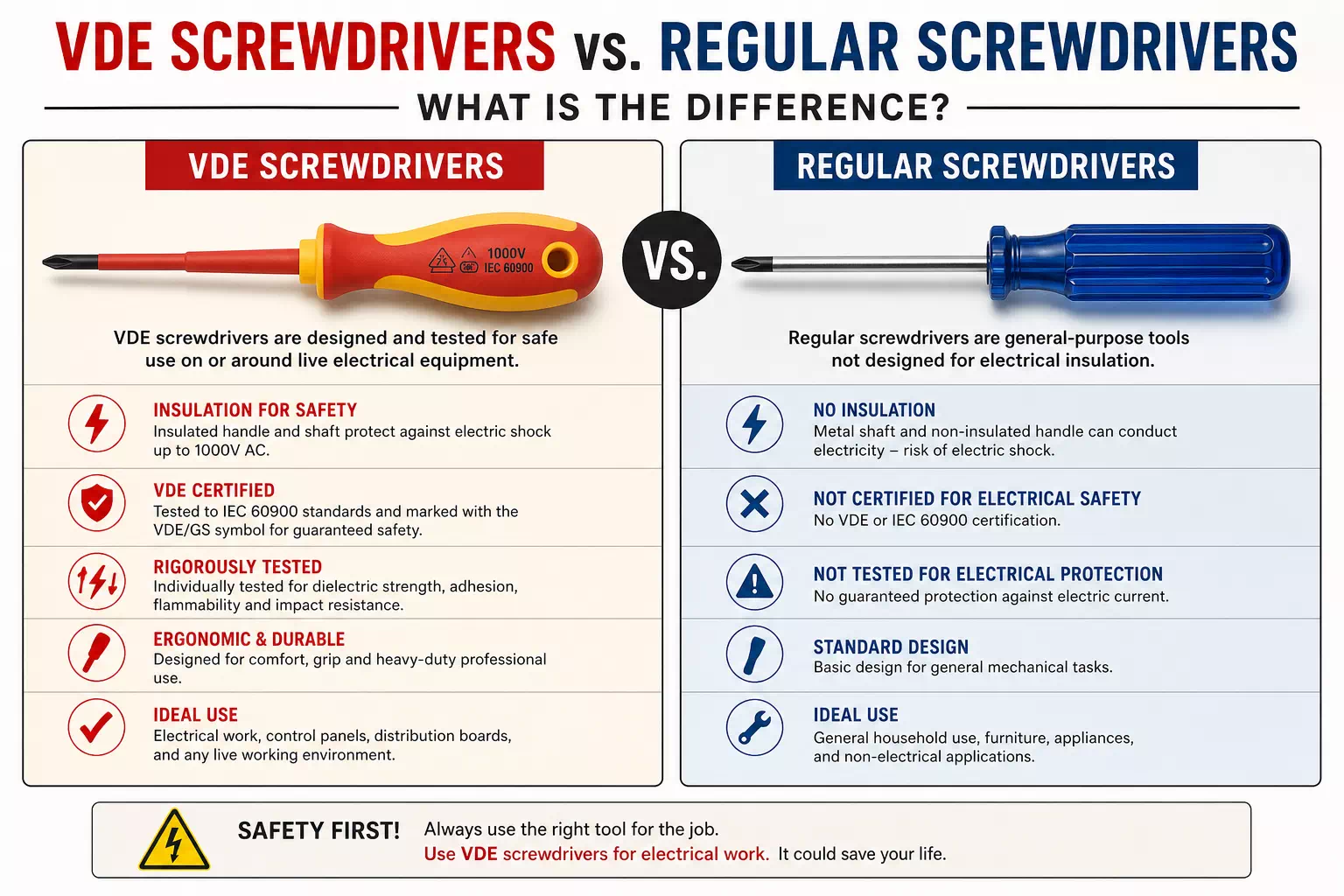
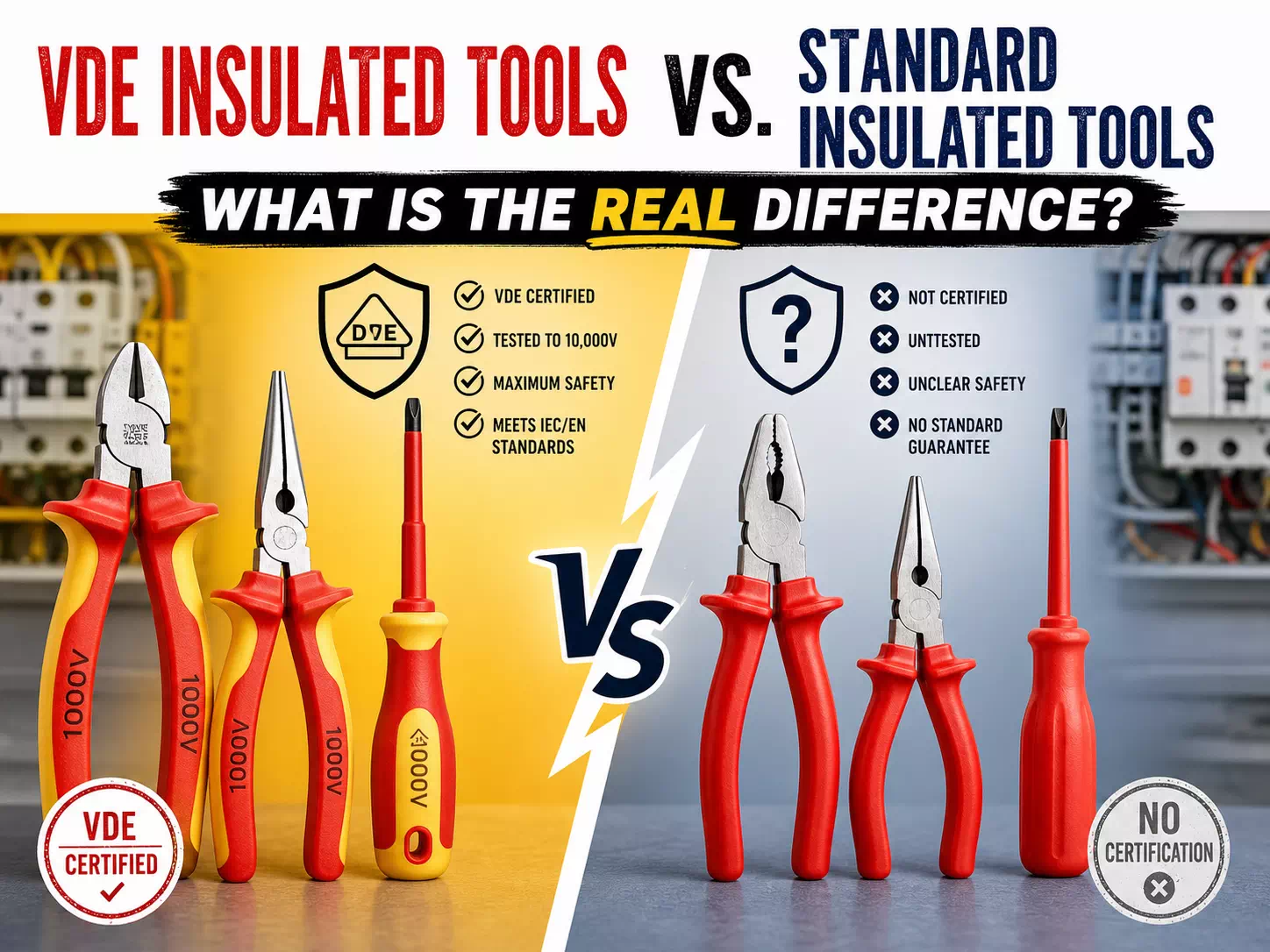
For electrical applications, also check whether a product is a standard hand tool or a properly rated insulated tool. Ordinary plastic or rubber-dipped handles should not be assumed to provide certified electrical protection.
Read Dawei's guide to choosing a 1000V VDE insulated tool set for additional information about selecting tools for electrical work.
5. Consider Tool Assortments for Resale
Retailers and distributors may find it more practical to offer combination pliers, diagonal cutters, and needle nose pliers together rather than relying on one general-purpose tool to cover every task.
For customers purchasing complete kits, Dawei's WIB-244, WIB-245, and WIB-246 tool set series provides another product option to evaluate for workshop and general maintenance markets.
Why Source Pliers from Dawei Metal?
Dawei Metal is a hardware tools manufacturer and export supplier serving international buyers. Its existing online product range includes combination pliers, diagonal cutting pliers, needle nose pliers, and other hand tools for maintenance, assembly, repair, and workshop use.
Relevant product options include:
A-Type Combination Pliers with Dolphin Handle — 6-, 7-, and 8-inch models.
A-Type Diagonal Cutting Pliers with Dolphin Handle — 6-inch model.
A-Type Needle Nose Pliers with Dolphin Handle — 6- and 8-inch models.
B-Type Nickel-Plated Combination Pliers — 6-, 7-, and 8-inch models.
B-Type Nickel-Plated Diagonal Cutting Pliers — 6-inch model.
B-Type Nickel-Plated Needle Nose Pliers — 6- and 8-inch models.
For wholesale inquiries, buyers should specify the required models, sizes, handle colors, surface finishes, packaging details, estimated order quantity, and destination market. Any OEM branding, custom packaging, or certification requirements should be agreed upon before production.
Frequently Asked Questions
What is the main difference between combination pliers and diagonal cutters?
Combination pliers are designed for general gripping, bending, holding, and some cutting tasks. Diagonal cutters are primarily designed to cut wire and trim small projecting components. Use each tool within its rated capacity.
Are needle nose pliers the same as long nose pliers?
The terms are commonly used interchangeably. Both generally refer to pliers with narrow, elongated jaws designed to reach confined spaces and handle small components.
Can combination pliers replace lineman pliers?
Not in every application. Although both can grip and cut suitable wire, dedicated lineman pliers may have different jaw geometry, leverage, and cutting specifications. Check the actual model and rated capacity before substituting one for the other.
Which pliers are best for cutting electrical wire?
Diagonal cutters are commonly preferred for controlled wire cutting, provided the conductor material and size fall within the tool's rated capacity. Combination pliers and lineman pliers can also cut suitable wire when designed for that purpose. Larger cables may require dedicated cable cutters.
What material should buyers look for in professional pliers?
Review the manufacturer's stated steel specification, heat treatment, cutting-edge design, pivot construction, and corrosion-resistant finish. High-carbon steel is used in several Dawei plier models, but buyers should evaluate the complete specification rather than material claims alone.
Are standard pliers safe for live electrical work?
No. Standard pliers should not be used as a substitute for properly rated insulated tools. Electrical work must follow applicable isolation procedures, voltage verification, personal protective equipment requirements, and relevant workplace safety rules. Where insulated tools are required, verify the applicable standard and certification for the specific product.
Can Dawei provide pliers for wholesale or OEM orders?
Dawei's product pages describe customization options for selected models. Buyers can contact the company to confirm order quantities, product availability, logo and handle customization, packaging, and applicable certification requirements.
Request a Pliers Quote from Dawei Metal
Whether you are building a retail hand-tool assortment, sourcing workshop supplies, or specifying pliers for maintenance teams, the right selection starts with the task and the required product specifications.
Visit the Dawei pliers and wrench tools range to review available products, or contact Dawei Metal with your model requirements, target quantity, and OEM or packaging needs.
Send us your product list and target market to discuss suitable plier models for your wholesale or private-label project.