
Blog
Hot News
- Dawei Metal 2026 Chinese New Year Special Offer: Gallop into Success with Upgraded Tools!
- Aluminum Alloy Combination Tool Set for Home, Automotive, and Repair Use
- Striking Tools: Types, Uses, and How to Choose the Right One
- Highest Quality Hand Tools: Inside the World's Most Trusted Tool Brands
- Why a Machete Saw Belongs in Your Outdoor Kit
Contact Us
Company:Shandong Dawei Metal Materials Co., Ltd.
Tel:+8615666285386
Email:dwhardwaretools@gmail.com
Address:Room 1413, Building 8, Shandong Steel Xintiandi Plaza, No. 61 Gongye South Road, High-tech Zone, Jinan City
Blog
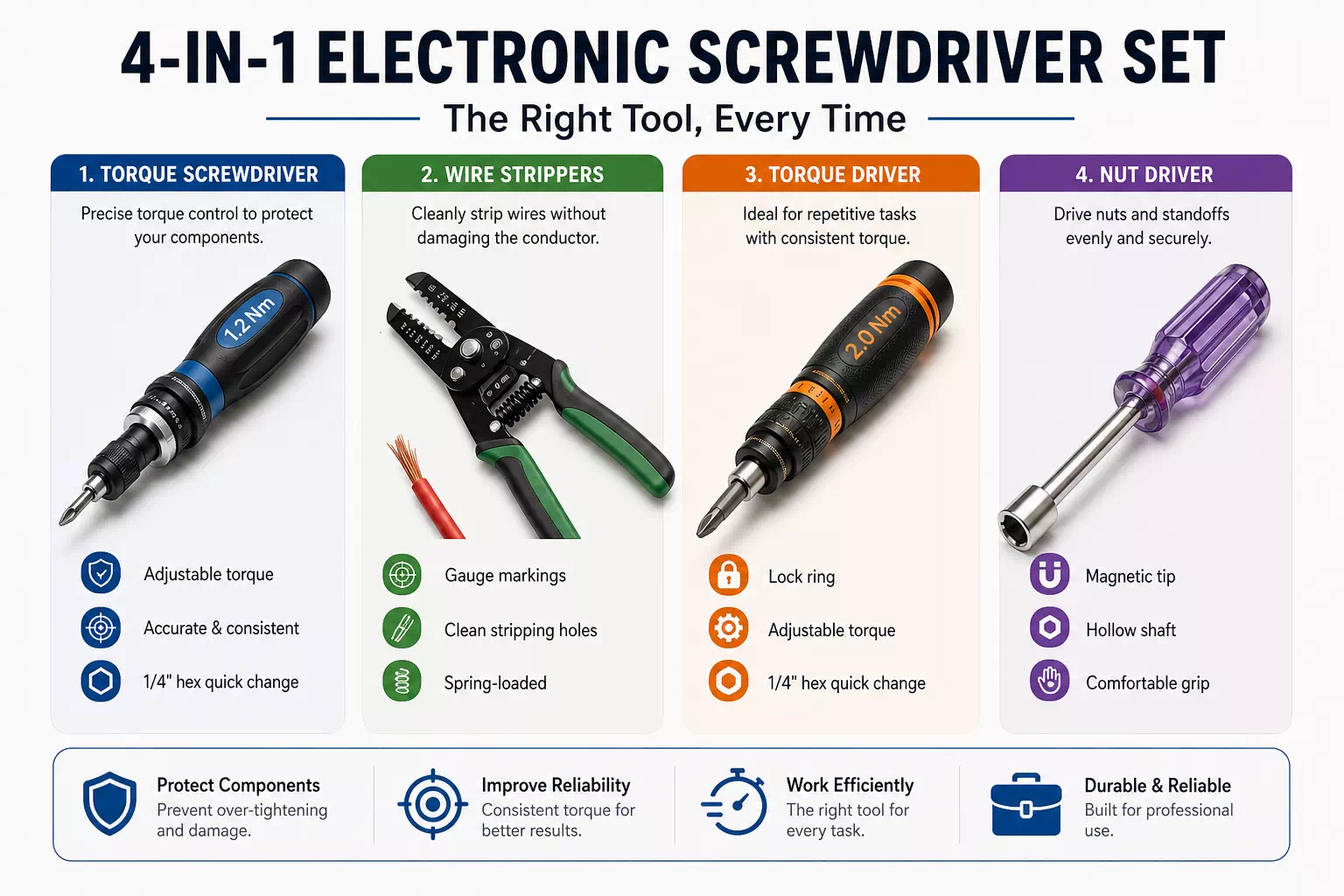
Torque Screwdrivers, Wire Strippers, Torque Drivers, and Nut Drivers: A Practical Electronic Tooling Guide
Author:Editor Click: Release date:2026-10-21 14:03
A terminal screw can be tight and still be wrong. A wire can look stripped and still have damaged strands. A small electronic assembly can pass a quick visual check and fail later because a fastener was overtightened or a connector was not prepared consistently.
That is why these five product keywords often appear in the same purchasing brief: torque screwdrivers and torque drivers control fastening force, wire strippers prepare conductors, nut drivers handle small hex fasteners, and electronic tooling supports the delicate assembly and service work around components, terminals, connectors, and enclosures. They do different jobs, but the quality of one affects the next step.
This guide explains what each tool does, where it fits, and how to build a practical set for electrical maintenance, control-panel wiring, electronic assembly, and light production work.
What Does “Electronic Tooling” Include?
Electronic tooling is a broad term for the hand tools, precision tools, measuring accessories, and controlled assembly equipment used to build, wire, inspect, repair, or maintain electronic and electrical products.
The exact list depends on the work. A technician assembling small control devices may need precision screwdrivers, flush cutters, tweezers, a wire stripper, a crimping tool, and a torque screwdriver. A panel builder may need insulated screwdrivers, wire preparation tools, terminal tools, a label system, and a calibrated torque tool. A production line may add electric assembly drivers, bit control, fixture tooling, and process verification.
Common electronic tooling categories include:
•Precision and insulated screwdrivers
•Torque screwdrivers and torque drivers
•Wire strippers and cable preparation tools
•Flush cutters and side cutters
•ESD-safe pliers and tweezers where static-sensitive components are involved
•Crimpers and terminal insertion or extraction tools
•Nut drivers and small socket tools
•Digital multimeters and continuity testers
•Magnifiers, inspection lights, and gauges
•Tool cases, fixtures, and organized workholding accessories
The phrase does not describe one universal kit. Tool selection should follow the connector type, wire size, fastener specification, component sensitivity, production volume, and inspection procedure.
The Five Tools and Their Separate Jobs
Tool category | Main job | Typical work area | Main selection concern |
Torque screwdriver | Applies a controlled tightening force by hand | Terminal blocks, covers, connectors, small assemblies | Torque range, accuracy, drive type, calibration |
Torque driver | Applies controlled torque in a repetitive or powered process | Production lines, repeated fastening, quality-critical joints | Drive system, shut-off, controller, verification |
Wire stripper | Removes insulation without damaging the conductor | Control wiring, harnesses, panels, electronic connections | Wire range, conductor type, strip length, ergonomics |
Nut driver | Turns small hex nuts, standoffs, and hex-head fasteners | PCB standoffs, terminal hardware, enclosures | Hex size, shaft access, insulation, fit |
Electronic tooling | Supports assembly, wiring, inspection, and service | PCBs, control devices, enclosures, connectors, production benches | Application fit, precision, ESD needs, repeatability |
Torque Screwdrivers: Why Controlled Tightening Matters
A torque screwdriver applies a specified or adjustable amount of torque to a screw. Torque is the turning force applied around the fastener axis. In electrical and electronic assembly, the goal is usually a repeatable joint rather than simply the tightest possible screw.
Too little torque can leave a terminal loose, increase contact resistance, allow movement, or reduce resistance to vibration. Too much torque can strip threads, damage a terminal, deform a connector housing, crush a component, or break a small fastener.
A torque screwdriver is especially useful when the equipment manufacturer, connector manufacturer, or internal work instruction specifies a tightening value. It is also valuable when several operators need to produce the same joint across a production batch.
Festool’s screwdriving guidance emphasizes that torque and speed should be matched to the screw and material, and that excessive torque can damage screw heads and bits . In industrial electronic assembly, the same principle applies even when the fasteners are much smaller: controlled force matters more than the apparent size of the screw.
Manual torque screwdriver or powered torque driver?
A manual torque screwdriver is a good fit for maintenance, service work, laboratory benches, small-batch assembly, and jobs where the operator needs direct feedback. It is portable, relatively simple to configure, and useful when the workstations change frequently.
A powered torque driver is more suitable when production volume, cycle time, and repeatability justify a controlled assembly system. Electric assembly tools can include clutch shut-off, current control, transducer-based measurement, controllers, and data collection. Atlas Copco describes electric assembly tools for low-torque and quality-critical applications, including micro-torque screwdrivers and controlled shut-off systems .
The limitation is straightforward: a powered tool is not automatically more accurate for every task. It still needs the correct bit, setup, calibration or verification routine, fastener access, and operator training.
Torque Driver vs. Torque Screwdriver
The terms torque driver and torque screwdriver are sometimes used interchangeably, but buyers should clarify the actual tool format before ordering. A torque screwdriver is often a manual hand tool with an adjustable or preset torque mechanism. A torque driver may refer to a powered or production-oriented fastening tool, although some suppliers also use the term for manual torque tools.
For a repeatable assembly process, ask the supplier to specify:
•Manual or powered operation
•Torque range and unit
•Bit holder or socket interface
•Clutch shut-off, current control, or transducer feedback
•Direction of operation
•Calibration and verification method
•Controller, cable, battery, or fixture requirements
Do not purchase from the name alone. Confirm how the tool reaches the target torque and how the result will be checked. A powered torque driver may improve cycle time, but it still needs the correct bit, stable access, a suitable fastening sequence, and process verification.
Key torque screwdriver specifications
When comparing a torque screwdriver, check the following:
•Torque range: The required value should sit comfortably within the tool’s working range rather than at an extreme limit.
•Units: Confirm whether the scale uses N·m, cN·m, in-lb, or another unit. Do not mix units during purchasing or setup.
•Accuracy and repeatability: These are different. A tool can show a target value clearly but still require verification to confirm its performance.
•Drive type: Common interfaces include hex bit holders and square drives. Match the tool to the bits and sockets used at the workstation.
•Direction: Check whether the tool is intended for clockwise tightening only or for controlled torque in both directions.
•Adjustment method: Some tools use a preset value; others allow the operator to adjust the setting across a range.
•Calibration and verification: Confirm how the tool will be checked and how often it will be calibrated under the company quality system.
•Ergonomics: A tool that is difficult to hold straight can produce inconsistent results even when its nominal specification is suitable.
A torque screwdriver should be selected from the joint specification backward. Start with the required torque, fastener, bit, access, and production method. Do not begin with a piece count or a visually attractive case.
Wire Strippers: Preparing the Conductor Correctly
Wire strippers remove insulation from a conductor so it can be inserted into a terminal, crimp contact, connector, or other electrical termination. Their job is more precise than simply cutting a piece of plastic away.
The stripper should remove the required length of insulation while leaving the conductor intact. A nicked copper strand, damaged insulation at the strip boundary, or an incorrect strip length can create problems during crimping and termination.
Jonard describes wire stripper/cutters as tools used to remove insulation and cut wire, with some models also offering crimping functions . That combination can be useful, but the tool should be judged by the wire sizes and connector system used at the workplace rather than by the number of features listed on the package.
Common wire stripper types
Fixed-gauge wire strippers
A fixed-gauge stripper has dedicated cutting notches for specific conductor sizes. It provides a clear tactile reference and is useful when the work repeatedly uses a known range of wires.
Its limitation is coverage. If the wire size falls between the available notches, forcing the conductor into the nearest size can damage the strands or leave the insulation partly attached.
Automatic wire strippers
Automatic strippers adjust around the conductor and can speed up repetitive work across several sizes. They are useful on benches and in maintenance work where the wire range changes frequently.
The jaws still need to match the conductor and insulation type. Thin, flexible, multi-layer, or unusually tough insulation may require a tool designed for that material.
Precision wire strippers
Precision strippers are used for small conductors, control wiring, sensor leads, and compact electronic assemblies. They are useful when the available space is limited and the strip length must be controlled carefully.
Do not assume that a precision tool is suitable for heavy cable. Small cutting geometry has a defined mechanical limit.
Coaxial and multi-layer cable strippers
Coaxial and multi-layer cables often require controlled preparation of several layers. A general-purpose wire stripper may remove the outer jacket but damage the shield, dielectric, or inner insulation. Use a cable-preparation tool intended for the cable construction.
Wire stripper specifications to check
•Conductor range in mm² or AWG
•Solid or stranded conductor compatibility
•Copper, aluminum, or other conductor material
•Insulation type and thickness
•Strip-length control or stop
•Integrated cutter or crimper, if required
•Jaw replacement or adjustment options
•Handle design and hand force
•Insulation rating if the tool is used in electrical environments
For many control-wiring tasks, an insulated wire stripper covering a range around 0.2–6 mm² may be useful, but this is not a universal specification. The actual range should follow the conductors used at the site.
How Wire Strippers Affect Termination Quality
The quality of a connection starts before the conductor reaches the terminal. A clean strip exposes enough conductor for a reliable termination without leaving unnecessary bare metal outside the connector.
A strip that is too short may prevent the conductor from reaching the proper contact area. A strip that is too long can leave exposed copper, reduce insulation support, or create a clearance problem inside a compact enclosure.
When a terminal or connector manufacturer provides a strip-length instruction, follow it. Do not estimate the length by eye when the assembly is safety-critical or repeated at production scale.
After stripping, inspect the conductor. Look for cut strands, flattened sections, pulled insulation, loose strands, and contamination. If the wire is damaged, cut it back and prepare a fresh end rather than hiding the defect inside a crimp or terminal.
Nut Drivers in Electronic Tooling
A nut driver is a small hand tool with a hexagonal socket at the end of a shaft. It is used to tighten or loosen hex nuts, hex-head screws, terminal hardware, and threaded standoffs. In electronic assembly, nut drivers are common around PCB standoffs, panel hardware, small enclosures, and terminal connections.
Nut drivers are useful because the hollow shaft can reach a nut on a threaded stud while the handle remains clear of the assembly. They are not the same as a socket wrench set: a nut driver is usually slimmer and easier to control for small fasteners, while a socket and ratchet provide more leverage and may suit larger or recessed hardware.
When selecting a nut driver, check the hex size, shaft length, clearance around the fastener, handle shape, and whether insulation is required for the electrical environment. If the fastener has a specified torque, use a compatible torque nut driver or torque-controlled socket system rather than relying on hand feel.
Electronic Tooling for Assembly and Maintenance
Electronic tooling is most useful when the work combines small parts, limited access, repeatable operations, and a need to protect components or finishes.
A practical electronic assembly bench may include:
•Precision slotted, Phillips, Pozidriv, and Torx screwdrivers
•A manual torque screwdriver for specified fasteners
•Fine-tip pliers and ESD-safe tweezers where required
•Flush cutters for trimming leads and cable ties
•Wire strippers matched to the conductor range
•Crimping tools for the specified terminals
•Nut drivers for hex standoffs and small fasteners
•A continuity tester or digital multimeter
•Magnification and task lighting
•ESD control equipment when the components require it
•A labeled tray or fixture for parts and tools
Not every bench needs every item. For example, a harness technician may need more wire preparation and crimping tools than precision screwdrivers. A PCB repair station may prioritize fine tips, magnification, soldering equipment, ESD controls, small torque drivers, and nut drivers for standoffs and enclosure hardware.
The key is to define the work sequence. If the operator strips a wire, crimps a terminal, installs it into a connector, and tightens a cover screw, the tooling should support each step without forcing the operator to improvise.
Matching the Five Keyword Areas to Real Workflows
Control-panel wiring
A control-panel workflow often includes wire cutting, stripping, ferrule or terminal preparation, routing, labeling, and fastening. The wire stripper should match the conductor range. The torque screwdriver or torque driver should match the terminal or cover fastener specification. A nut driver may be useful for small hex hardware, but it should not be used to guess the tightening torque. Insulated screwdrivers, pliers, and wire tools should be selected for the electrical environment and inspected before use.
Dawei Metal’s guide to choosing insulated tools for electrical work covers insulated screwdrivers, pliers, wire strippers, wrenches, sockets, and tool-kit configuration.
Electronic device assembly
Electronic device assembly usually needs more attention to fastener size, surface finish, component clearance, and repeatability. A small torque screwdriver helps prevent stripped threads and crushed housings. Precision wire strippers help prepare small conductors without damaging strands. Other electronic tooling should be chosen around the connector and component system.
If the product includes static-sensitive components, ESD control becomes part of the tooling decision. A mechanically precise tool is not enough if the work environment can expose the component to uncontrolled electrostatic discharge.
Equipment maintenance
Maintenance work is less predictable than production assembly. The technician may encounter several fastener sizes, old insulation, limited access, contamination, or previously damaged hardware. A compact electronic tooling kit should therefore include a range of precision drivers, a suitable wire stripper, cutters, a meter, a torque screwdriver or torque driver, and nut drivers for the hex hardware found on the equipment.
The kit should also include a clear process for damaged tools. A cracked insulated handle, distorted stripper jaw, rounded screwdriver tip, or torque tool with an overdue verification status should be removed from service.
Small-batch OEM production
Small-batch production needs a balance between flexibility and repeatability. Manual torque screwdrivers may be sufficient for low volumes, while a powered electronic assembly tool may become worthwhile when the same joint is repeated hundreds of times or when traceable process data is required.
Wire strippers should be set up for the actual harness and connector specification. A general-purpose tool may be adequate for development work but slow or inconsistent in a production batch. Electronic tooling should be organized so that the operator can identify the correct tool and return it to the same position after use.
Selecting a Tool Set for Electronic Assembly
A purchasing specification should describe the work rather than simply asking for an “electronic tool set.” Include:
•Fastener types and sizes
•Required torque values and tolerances
•Conductor types and cross-sections
•Strip lengths
•Connector and terminal families
•Required crimp profiles
•Insulation or voltage requirements
•ESD requirements
•Expected daily cycle count
•Calibration and verification expectations
•Replacement parts and service support
•Case, pouch, or workstation storage requirements
For electrical maintenance buyers, Dawei Metal’s insulated tools and insulated tool set guide can help compare individual tools with complete electrician kits. For a larger set that includes insulated sockets and other hand tools, review the VDE insulated electrician tool set, while confirming current certification and packing details with the supplier before purchase.
When to buy individual tools
Buy individual tools when the task is specialized, the team already owns a standard kit, or a damaged item needs replacement. This approach can reduce duplicate pieces and make it easier to choose the exact stripper range or torque scale required.
When to buy a complete set
A complete set can be useful for a new workstation, field team, training program, or distributor product line. The advantage is organization and coverage. The limitation is that a fixed set may contain tools that do not match the target market while missing a tool that is used every day.
When to consider OEM customization
OEM buyers may need a private-label case, handle color, logo, tool combination, or packaging format. Any change to a torque mechanism, insulation system, calibration specification, or working profile should be treated as a technical change and confirmed with the supplier.
Common Selection Mistakes
Choosing a torque range that is too broad
A very broad range can look efficient, but the tool may be less suitable at the low or high end of its scale. Start with the actual joint requirements and choose a range that gives the operator useful control.
Treating a wire cutter as a wire stripper
Cutting insulation with a knife or plier edge can nick the conductor. Use a stripper designed for the wire and insulation type.
Buying by piece count
A large electronic tooling kit may still be incomplete for a specific connector system. Compare the working ends, ranges, torque values, and accessories instead of counting pieces alone.
Ignoring calibration
A torque screwdriver is a measuring and control tool. If the workplace depends on a specified torque, include calibration or verification in the tool’s service plan.
Using a torque screwdriver as a breaker bar
A torque screwdriver is not intended to loosen seized fasteners unless the manufacturer specifically allows that operation. High breakaway torque can damage the mechanism or invalidate its accuracy.
Using insulated tools as a substitute for safe electrical practice
Insulated wire strippers, screwdrivers, and torque tools can reduce risk when correctly designed and maintained. They do not replace isolation, voltage verification, PPE, training, or the site’s electrical safety procedure.
Inspection and Maintenance
Inspect all three tool groups before use.
For torque screwdrivers, check the housing, adjustment mechanism, bit holder, scale, locking function, and verification status. Do not use a tool if it has been dropped or if the setting cannot be controlled reliably.
For wire strippers, inspect the cutting edges, stripping notches, pivot, jaw alignment, insulation, and adjustment mechanism. Remove the tool if it tears insulation, cuts strands, or no longer holds the conductor correctly.
For electronic tooling, check tips, jaws, shafts, handles, ESD markings where relevant, and the storage tray. Keep small tools clean and dry. Metal filings, solder residue, oil, and dust can interfere with fine mechanisms and contaminate assemblies.
Store tools in labeled positions. A fitted case or organized workstation makes missing tools, mixed sizes, and damaged working ends easier to identify. Dawei Metal’s guide to maintaining and storing insulated tools provides a related routine for inspection, cleaning, moisture control, and storage.
Frequently Asked Questions
What is a torque screwdriver used for?
It is used to tighten screws to a specified or controlled torque. It is useful when overtightening or undertightening could affect electrical contact, component integrity, thread condition, or product consistency.
What is the difference between a torque driver and a torque screwdriver?
The terms vary by supplier. A torque screwdriver usually describes a manual hand tool, while a torque driver may describe a powered or production-oriented tool. Confirm the operating method, torque mechanism, interface, and verification process instead of relying on the name alone.
What is a nut driver used for?
A nut driver turns small hex nuts, hex-head fasteners, and threaded standoffs. It is common in electronic assemblies, control hardware, and small enclosures. Choose the correct hex size and use a torque-controlled version when the joint has a specified tightening value.
How do I choose a wire stripper?
Match the stripper to the conductor size, conductor material, insulation type, strip length, and work environment. The tool should remove insulation without nicking the conductor or leaving an incorrect amount of exposed metal.
What does electronic tooling include?
Electronic tooling includes the hand tools and controlled assembly equipment used for electronic and electrical work. It may include precision screwdrivers, torque screwdrivers, wire strippers, cutters, crimpers, tweezers, nut drivers, meters, ESD tools, and inspection accessories.
Is a powered electric screwdriver better than a manual torque screwdriver?
Neither is automatically better. A manual torque screwdriver is often practical for service and low-volume work. A powered tool can improve repeatability and cycle time in higher-volume assembly when it is correctly configured, verified, and maintained.
Should wire strippers be insulated?
If the tool may be used near energized electrical parts, select a tool with the appropriate insulation design, voltage marking, and applicable documentation. Insulation does not remove the need to de-energize circuits whenever possible.
How often should a torque screwdriver be calibrated?
The interval should follow the manufacturer’s guidance and the company’s quality system. Usage frequency, risk, impact events, and customer or regulatory requirements may affect the schedule. A tool that has been dropped or behaves inconsistently should be checked before further use.
Can one electronic tooling kit cover PCB assembly and control-panel wiring?
It can cover some common tasks, but the two applications often need different tool ranges and protections. PCB work may require finer tips, ESD controls, and small torque values. Panel wiring may require insulated tools, larger wire ranges, and more robust terminal hardware.
Conclusion
A torque screwdriver, torque driver, wire stripper, nut driver, and the wider electronic tooling set solve different problems in the same workflow.
The torque screwdriver or torque driver controls how much force reaches the fastener. The wire stripper controls how the conductor is prepared. The nut driver handles small hex hardware and standoffs. The wider electronic tooling set gives the operator the precision, access, inspection, and protection needed to complete the assembly without improvising.
Choose each tool from the work specification: torque value, fastener, wire range, strip length, connector, environment, production volume, and inspection requirement. For professional electrical work, also verify insulation ratings, markings, and the condition of the tool before use.
A well-configured set is not necessarily the one with the most pieces. It is the set that matches the actual assembly and can be checked, maintained, and replaced without disrupting the work.
Label:
Related News
Latest product
-
Torque Screwdrivers, Wire Strippers, Torque Drivers, and Nut Drivers: A Practical Electronic Tooling
-
How to Choose a Rolling Tool Cabinet: 6 Drawers or 17?
-
How to Choose a Gear Wrench Tool Set for Motorcycle Maintenance
-
VDE Screwdrivers vs. Regular Screwdrivers: What Is the Difference?
-
VDE Insulated Tools vs. Standard Insulated Tools: What Is the Real Difference?
-
VDE Certification Explained: What “VDE Approved” Really Means for Insulated Tools