
- Dawei Metal 2026 Chinese New Year Special Offer: Gallop into Success with Upgraded Tools!
- Aluminum Alloy Combination Tool Set for Home, Automotive, and Repair Use
- Striking Tools: Types, Uses, and How to Choose the Right One
- Highest Quality Hand Tools: Inside the World's Most Trusted Tool Brands
- Why a Machete Saw Belongs in Your Outdoor Kit
Company:Shandong Dawei Metal Materials Co., Ltd.
Tel:+8615666285386
Email:dwhardwaretools@gmail.com
Address:Room 1413, Building 8, Shandong Steel Xintiandi Plaza, No. 61 Gongye South Road, High-tech Zone, Jinan City
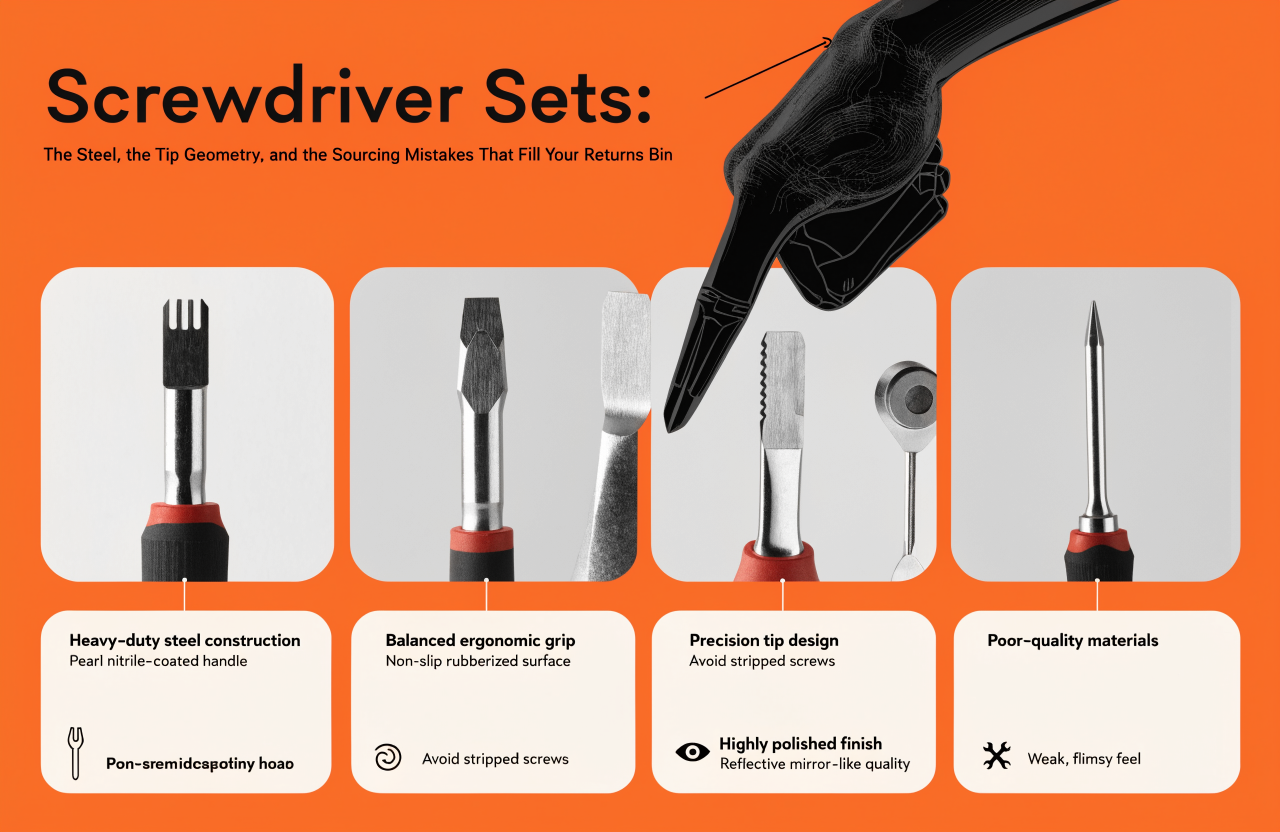
Screwdriver Sets: The Steel, the Tip Geometry, and the Sourcing Mistakes That Fill Your Returns Bin
A screwdriver is the simplest tool in the box. A steel shaft, a handle, and a tip that fits a slot. Nothing to get wrong.
And yet it's the highest-return SKU in the hand tool category for most distributors I've worked with. The complaints are always the same three things: the tip strips the screw head on the first use, the shaft bends under normal hand torque, or the handle spins loose on the tang after a few weeks.
None of these failures are random. Every one traces back to a spec the buyer didn't verify during sampling. I've been running heat-treat and assembly lines at our factory for over twelve years, and I've analyzed enough failed screwdrivers under a microscope to tell you exactly where the money is being wasted.
Shaft Steel: S2 vs. Cr-V vs. Carbon — The Hardness-Toughness Tradeoff
The shaft has to transmit torque from the handle to the tip without twisting, bending, or snapping. The steel grade determines whether it does that for 10,000 cycles or 100.
The fundamental tradeoff most buyers miss: hardness and toughness are inversely related. A shaft that's too hard resists tip wear but snaps under lateral load. A shaft that's too tough bends instead of breaking but the tip rounds off fast. The right steel sits in the narrow band where both properties are adequate.
| Steel Grade | Shaft HRC | Tip HRC | Tensile Strength | Cost Delta | Best Application |
| C45 Carbon | 38–42 | 48–52 | ~700 MPa | Baseline | Promotional / giveaway |
| 50BV30 Cr-V | 44–48 | 54–58 | ~1,050 MPa | +15–20% | General-purpose / DIY |
| 6150 Cr-V | 48–52 | 56–60 | ~1,200 MPa | +25–35% | Professional / automotive |
| S2 Tool Steel | 50–54 | 58–62 | ~1,100 MPa | +30–45% | Impact-rated / industrial |
S2 steel is the premium choice for any application where the screwdriver might see impact loading — a mechanic tapping the handle with a hammer to break a seized screw, or a construction worker using a Phillips driver as a makeshift pry bar (which they absolutely shouldn't do, but they do it every day). S2 is a shock-resistant tool steel with silicon and molybdenum. The silicon gives it a high elastic limit, so the shaft flexes under lateral load and springs back without taking a permanent set.
Cr-V (6150) is the workhorse for mid-range sets. Harder than S2 at equivalent temper, which gives better tip wear, but more brittle. A 6150 shaft will snap before it bends under enough lateral force. For normal hand-torque applications — furniture assembly, terminal blocks, general maintenance — 6150 is perfectly adequate and more cost-effective.
C45 carbon steel is the budget option. We use it only for promotional sets that ship inside a product box as a freebie. The tip rounds off within a few dozen uses on hardened screws. Fine for a homeowner who tightens a cabinet hinge twice a year. Brand poison for professional users.
The spec to demand: Ask for a cross-section hardness profile, not a single surface reading. The shaft should show a gradient — typically 2–4 HRC harder at the surface if induction-hardened. Uniform hardness from core to surface means through-hardening, which means the shaft is either too brittle or too soft. Neither is acceptable.
Drive Type Geometry: Phillips vs. Pozidriv vs. JIS — The Confusion That Strips Screws
This is where a knowledgeable buyer separates from one who just copies a competitor's SKU list. The three most common cross-head drives look almost identical, but the flank angles, tip geometry, and torque transfer are fundamentally different. Mixing them up is the number one cause of stripped screw heads in the field.
Phillips (PH) was invented in the 1930s and is designed to cam out. The tapered flanks push the driver out of the recess when torque exceeds a threshold. This was intentional on 1930s aircraft assembly lines to prevent over-torquing aluminum skins. The problem is that cam-out destroys the screw recess after two or three engagements.
Pozidriv (PZ) adds four secondary radial ribs at 45° to the main cross. These engage matching fins on the driver tip and prevent cam-out. A Pozidriv driver transmits roughly 2–3× more torque than a Phillips of the same size. The visual tell: a Pozidriv screw head has four small tick marks between the main cross slots. Use a PH driver in a PZ screw and it cams out immediately.
JIS (Japanese Industrial Standard B 4633) is used on virtually every Japanese motorcycle, car, and electronic device. It looks almost identical to Phillips, but the flank angle is steeper and the tip radius is tighter. A Phillips driver in a JIS screw sits too shallow and cams out under moderate torque. If your screwdriver set is going into a motorcycle tool kit — like the gear wrench and motorcycle sets we covered previously — include JIS drivers in the PH1 and PH2 sizes. Japanese bike manufacturers used JIS screws almost exclusively on engine covers and carburetors.
| Drive Type | Cam-Out Resistance | Visual Identifier | Primary Market |
| Phillips (PH) | Low (by design) | Rounded cross, no tick marks | North America (legacy) |
| Pozidriv (PZ) | High | Cross + 4 tick marks at 45° | Europe |
| JIS | High | Cross, dot stamped on head | Japan, Asia (motorcycles) |
| Torx (T) | Very High | 6-point star | Automotive, aerospace |
Torx is rapidly replacing Phillips in automotive applications. The 6-point star geometry provides near-zero cam-out. If your set targets the automotive aftermarket, include T15, T20, T25, and T30. European vehicles use Torx extensively on brake calipers, interior trim, and engine components.
The manufacturing detail: Tip geometry on a quality screwdriver is cold-formed or ground to match the exact flank angle per ISO 8764-1. A Phillips PH2 tip must have a flank angle of 57° ± 1°. If the tip is ground by hand on a bench grinder — still common in small factories — the angle scatters across ±5° and the driver either cams out prematurely or fails to seat fully. We cold-form our tips on heading machines and finish-grind on CNC profile grinders, checking every 500th piece on an optical comparator.
Insulated Screwdriver Sets: IEC 60900 and the 10kV Water Bath Test
If your insulated screwdriver set is going anywhere near a live electrical panel, the insulation is a life-safety requirement. The difference between a real IEC 60900 certified tool and a cheap imitation with a red-and-yellow handle is the difference between saving an electrician's life and ending it.
We covered IEC 60900 basics in our pliers and cutting tools guide, but screwdrivers have their own failure modes.
The dual-layer molding process:
Inner layer (dielectric barrier): Polypropylene (PP), minimum 2.5mm thick, molded directly onto the grit-blasted steel tang. This is the primary insulation. The bond between PP and steel is critical — poor surface prep causes delamination under thermal cycling.
Outer layer (mechanical protection): Polyamide (PA6/PA66), minimum 1.5mm thick, overmolded onto the PP. Provides impact resistance, chemical resistance, and the red/yellow color coding.
The 10kV test: Every single insulated screwdriver we produce — not a sample, every individual tool — goes through a dielectric withstand test at 10,000V AC for 60 seconds in a water bath. The tool is submerged to within 20mm of the tip, and 10kV is applied between the steel core and the water. Leakage current above 0.5mA means the tool is scrapped. No rework.
This catches pinholes in the PP layer, insufficient wall thickness at the taper zone near the tip, and delamination between the insulation and the steel.
| Primary Market | Non-Certified "1000V" | IEC 60900 Certified |
| Handle Construction | Single-layer PVC dip | Dual-layer PP + PA injection |
| Dielectric Test | None or random sample | 10kV, 100% individual |
| Impact at -25°C | Not tested | 1kg from 1m, no crack |
| Marking | Printed "1000V" | Molded double-triangle ⧈ |
| Shaft Exposure Limit | Varies | Max 18mm exposed steel |
For our full range of VDE insulated screwdriver sets, check the product pages on our site.
Handle Materials and the Pull-Off Force Test
The handle is the interface between the user's hand and the tool. A bad handle causes blisters, reduces torque transfer, and spins loose on the tang.
Polypropylene (PP): Most common. Cheap, durable, chemical-resistant. Downside: slippery when wet or oily, reducing grip torque by 20–30%. Fine for general-purpose sets.
TPR/TPE overmold: Soft rubber layer over a rigid PP core. Excellent grip in greasy conditions. Standard TPR degrades after 3–5 years in UV and petroleum exposure — it gets sticky and peels. We use a TPE compound for better chemical resistance at a 15–20% cost premium.
Cellulose Acetate (CA): The classic amber or red translucent handle on vintage Stanley and Craftsman screwdrivers. Extremely hard and durable, doesn't degrade with age. Brittle on impact — cracks if dropped from waist height onto concrete. We offer CA handles on premium sets for the North American market where the aesthetic still sells.
The pull-off force test: Per ISO 2380, the handle must withstand 150N axial pull without separating from the tang. We test to 250N internally to account for thermal cycling and chemical exposure in the field. The bond depends on tang geometry (fluted is strongest) and surface prep (grit-blasted, not smooth).
OEM Sourcing Checklist
Use this during your next factory audit:
Steel MTC — verify the alloy designation (S2, 6150, 50BV30), not just "Cr-V."
Hardness profile at tip, mid-shaft, and tang. Tip should be 6–10 HRC harder than tang.
Tip geometry verified against ISO 8764-1 on an optical comparator, not a caliper.
Handle pull-off force per ISO 2380, minimum 150N at 23°C and -10°C.
Dielectric test certificate for insulated models — 10kV, 100% inspection, serial-traceable.
MOQ and Pricing
Standard sets (6–12pc, Cr-V, PP/TPR): MOQ 1,000 sets. FOB $1.80–$5.50. Lead time 25–35 days.
VDE insulated sets (IEC 60900): MOQ 500 sets. FOB $4.50–$12.00. Lead time 35–45 days.
Custom bit assortments sound appealing but every non-standard size needs a separate cold-forming die at $800–$1,500. Unless you're ordering 5,000+ sets, pick from our standard bit library and customize the handle color and packaging instead. You get 90% of the branding impact at 10% of the tooling cost.
The View From the Assembly Line
A screwdriver set is the entry point for most hand tool buyers — the first SKU a hardware store stocks, the first item in a promotional kit, the most common holiday gift set. Volume is enormous. Competition is brutal.
The buyers who win understand that the screwdriver is deceptively complex. The tip geometry has to match the screw standard exactly. The steel has to balance hardness and toughness. The handle has to stay bonded through years of abuse. And if the set includes insulated models, the dielectric barrier has to protect a human life at 1000 volts.
None of this shows up in a product photo. All of it shows up in your return rate.
If you want to spec out a screwdriver set for your market — VDE electrician's set, general-purpose hardware assortment, or anything in between — talk to our engineering team before you finalize your order. We'll tell you honestly what spec is achievable at your target price and where the safety lines are that we won't cross.
-
Screwdriver Sets: The Steel, the Tip Geometry, and the Sourcing Mistakes That Fill Your Returns Bin
-
Rolling Tool Chest with Tools: How to Choose the Right Setup for Your Workshop
-
Insulated Pliers vs. Regular Pliers: What Is the Difference?
-
Combination Pliers vs. Diagonal Cutters, Needle Nose Pliers, and Lineman Pliers
-
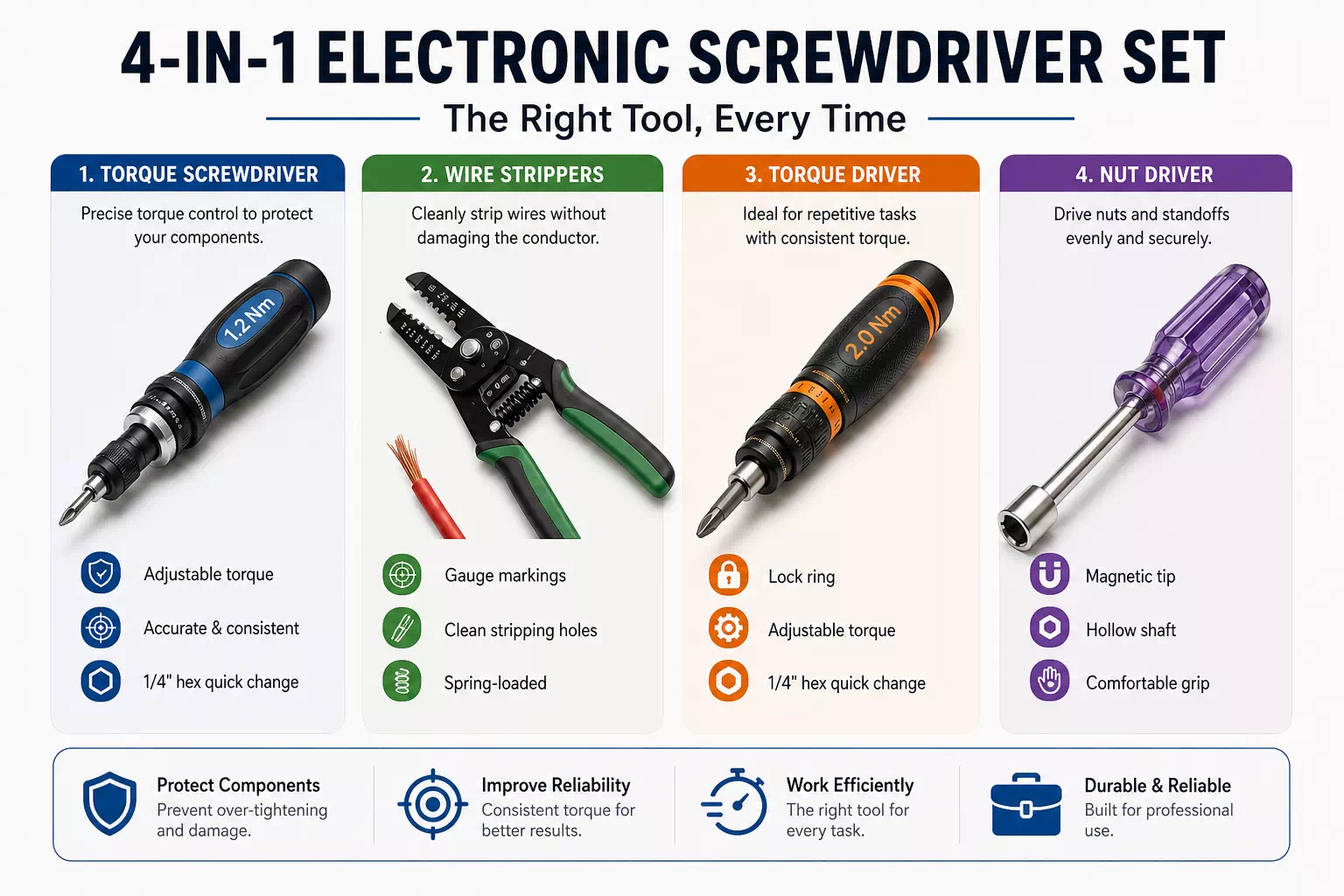
Torque Screwdrivers, Wire Strippers, Torque Drivers, and Nut Drivers: A Practical Electronic Tooling
-
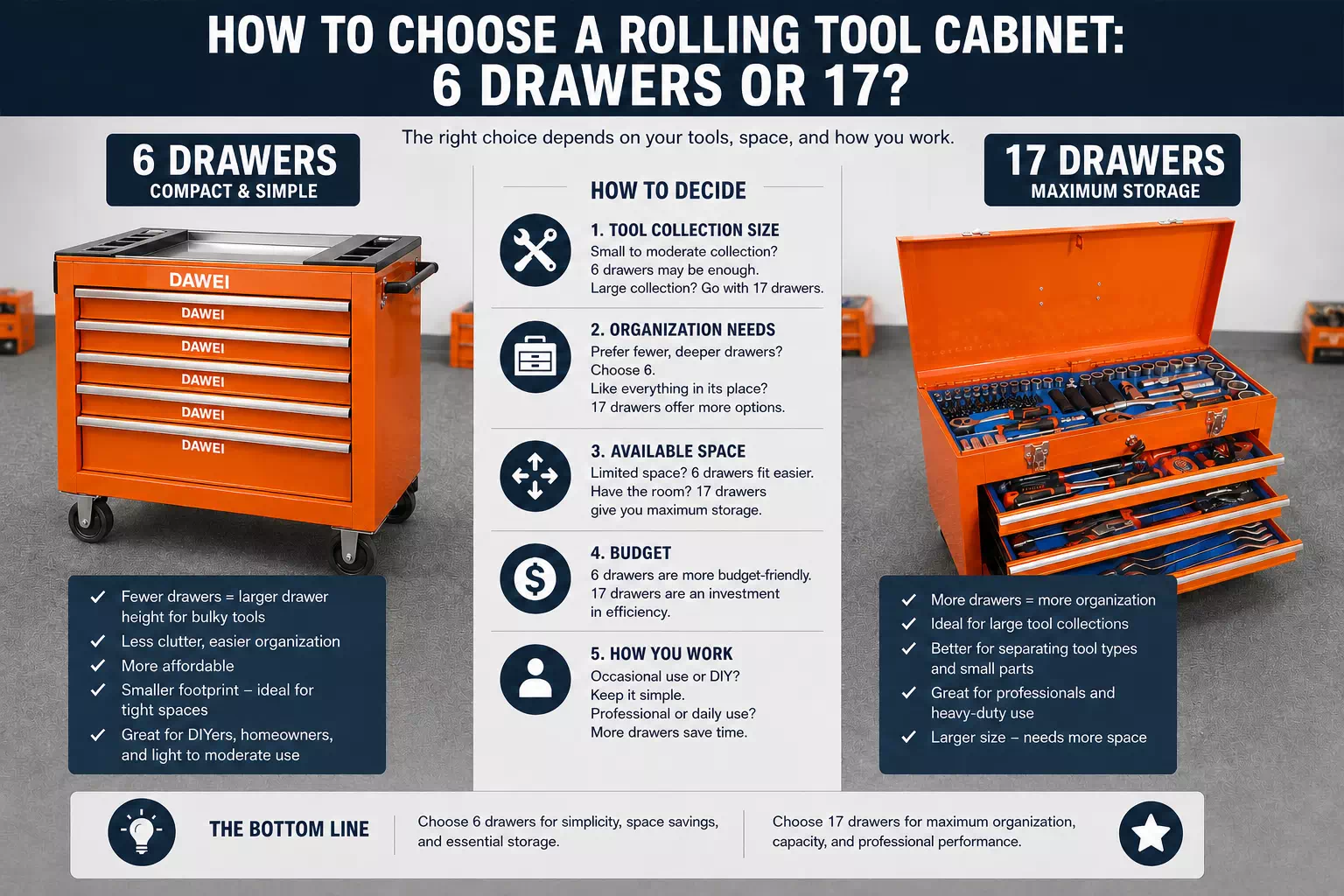
How to Choose a Rolling Tool Cabinet: 6 Drawers or 17?