
Blog
Hot News
- Dawei Metal 2026 Chinese New Year Special Offer: Gallop into Success with Upgraded Tools!
- Aluminum Alloy Combination Tool Set for Home, Automotive, and Repair Use
- Striking Tools: Types, Uses, and How to Choose the Right One
- Highest Quality Hand Tools: Inside the World's Most Trusted Tool Brands
- Why a Machete Saw Belongs in Your Outdoor Kit
Contact Us
Company:Shandong Dawei Metal Materials Co., Ltd.
Tel:+8615666285386
Email:dwhardwaretools@gmail.com
Address:Room 1413, Building 8, Shandong Steel Xintiandi Plaza, No. 61 Gongye South Road, High-tech Zone, Jinan City
Blog
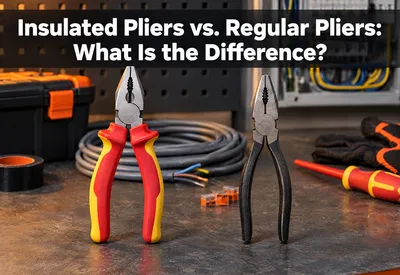
Insulated Pliers vs. Regular Pliers: What Is the Difference?
Author:Editor Click: Release date:2026-10-30 15:12
A pair of pliers can look electrically protected because the handles are red, yellow, or covered in plastic. That appearance proves very little by itself.
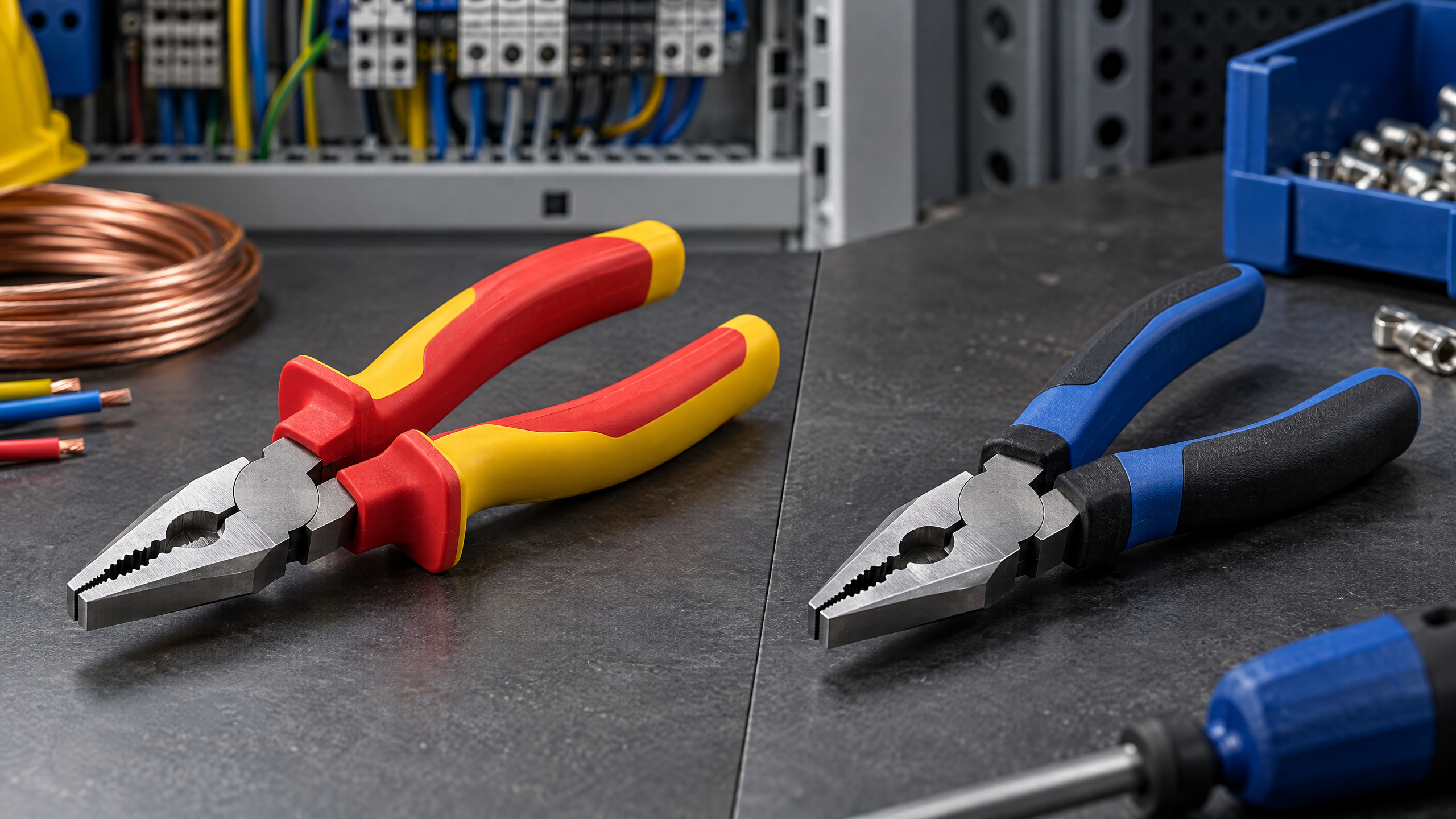
Insulated pliers and regular pliers have different electrical protection purposes, even when their jaw shapes look similar.
The real difference between insulated pliers and regular pliers is the tool’s intended electrical protection, construction, markings, testing, and documentation. Regular pliers are general mechanical tools. Insulated pliers are designed for work where the tool may approach energized parts or where the procedure requires an additional insulating barrier.
They do not make live work automatically safe. De-energization, isolation, voltage verification, PPE, and the site’s electrical safety procedure still come first.
Insulated Pliers vs. Regular Pliers at a Glance
| Feature | Insulated pliers | Regular pliers |
| Primary purpose | Electrical work with an additional insulating barrier | General gripping, bending, cutting, and maintenance |
| Handle construction | Purpose-designed insulation, often with finger guards | Metal, plastic, rubber, or cushion-grip handle |
| Electrical marking | May show voltage, standard, manufacturer, and traceability information | Usually no electrical protection marking |
| Typical standards | May be tested to requirements such as IEC 60900 | General hand-tool requirements |
| Main buying concern | Insulation, rating, documentation, and mechanical capacity | Jaw profile, steel, capacity, size, and ergonomics |
| Main limitation | Insulation does not replace safe electrical procedures | Not designed to provide electrical protection |
What Are Insulated Pliers?
Insulated pliers have a purpose-designed insulating system around the handles. Depending on the model, this may include molded layers, finger guards, end protection, voltage markings, and product identification.
The metal head still performs the mechanical work. The insulation is an additional barrier between the operator’s hand and conductive parts of the tool. A properly specified model should identify its manufacturer, product type, voltage marking, standard reference, and—where applicable—certification or test information.
Dawei Metal’s guide to choosing insulated tools for electrical work covers insulated combination pliers, long nose pliers, diagonal cutting pliers, side-cutting pliers, and other electrical hand tools.
Insulation can be cut, punctured, crushed, softened by chemicals, degraded by heat, or damaged by impact. Check the jaws and pivot as well. A loose pivot, chipped cutter, or bent tip can cause the tool to slip toward an energized part.
What Are Regular Pliers?
Regular pliers are general-purpose mechanical tools for gripping, bending, twisting, cutting, pulling, or holding a workpiece. They may have bare metal handles, paint, plastic sleeves, or soft cushion grips.
A cushion grip improves comfort. It does not automatically provide electrical insulation. The Canadian Centre for Occupational Health and Safety warns that cushion-grip handles should not be used where electrically insulated handles are required .
Regular pliers are suitable for general workshop maintenance, automotive repair, mechanical assembly, plumbing, fabrication, and other tasks where electrical protection is not required. Do not choose them for work near energized parts just because the handle is thick or non-metallic.
Construction and Marking Differences
Insulation and finger guards
Insulated electrical pliers may use a layered or two-color insulating system. A contrasting inner layer can make wear easier to see, but color alone is not proof of compliance. The marking and supporting documents still matter.
Finger guards help prevent the hand from sliding toward the conductive head. They improve control, but they cannot prevent every contact in a crowded cabinet or compensate for an incorrectly selected tool.
Mechanical capacity
Insulation does not increase a cutter’s capacity or make a needle nose tip suitable for heavy bending. Select the tool according to wire material, diameter, access, leverage, and required grip.
A tool can be electrically rated and still be mechanically unsuitable. It may slip, deform, or fail if the operator cuts hardened wire, overloads the pivot, or uses a narrow tip as a pry bar.
IEC 60900, VDE, and 1000V: What Do They Mean?
These terms should not be treated as interchangeable marketing claims.
IEC 60900 is an international standard associated with insulated and insulating hand tools for work near live parts under defined conditions. It covers requirements related to design, marking, and testing.
VDE refers to a German technical and testing organization. In product descriptions, “VDE approved” or “VDE tested” should be supported by documentation for the exact model being purchased.
1000V is a voltage marking or product claim. It must be read together with the applicable standard, AC or DC context, intended use, and documentation. It is not permission to work casually on any 1000V system.
Before buying, confirm:
•The exact model covered by the document
•Voltage marking and AC/DC context
•Applicable standard and edition
•Whether the document is a certificate, test report, or declaration
•Manufacturer, model, and traceability information
•Local or customer-specific requirements
A colored handle, “1000V” print, or the word “VDE” alone does not prove the same level of approval.
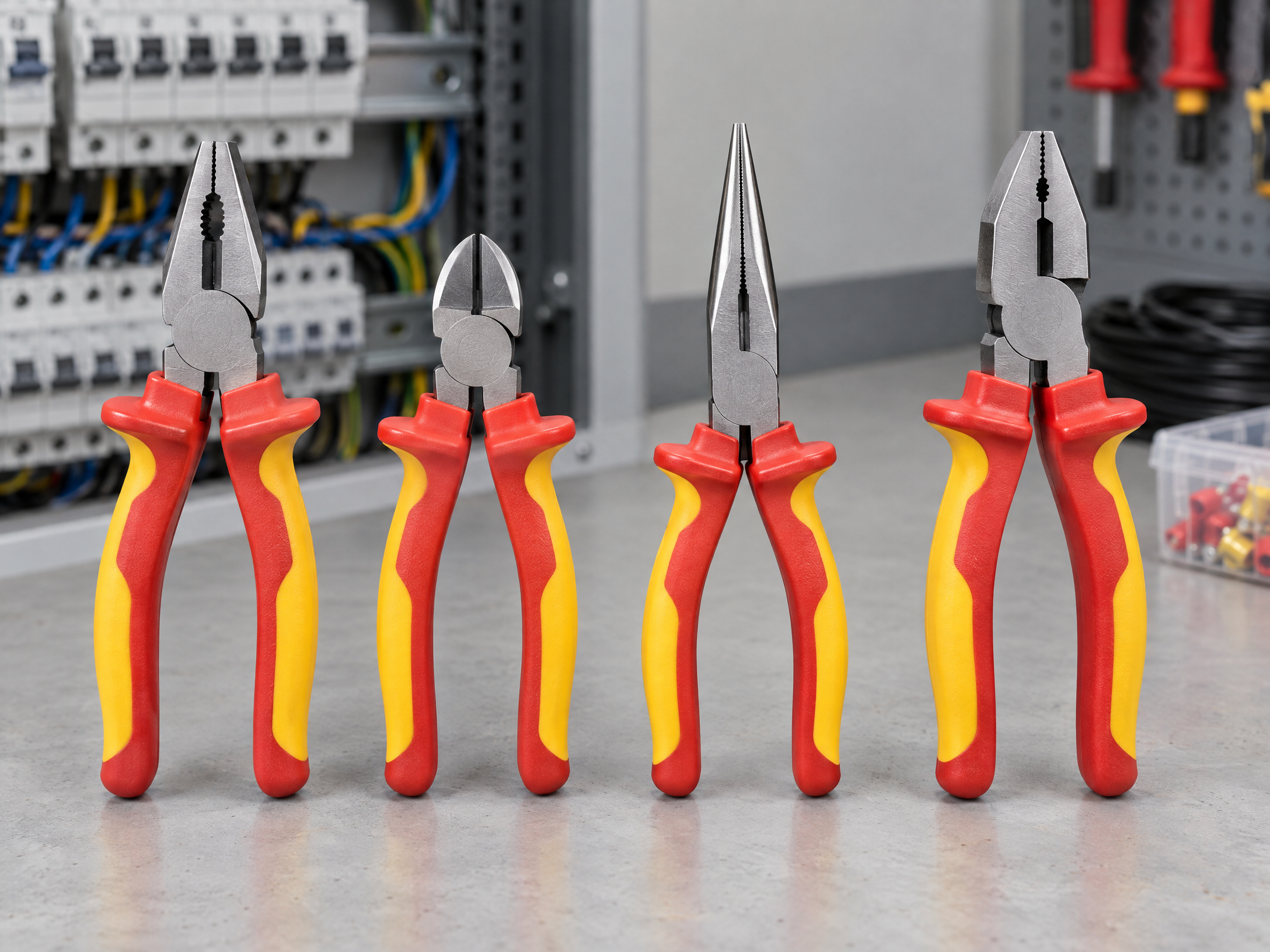
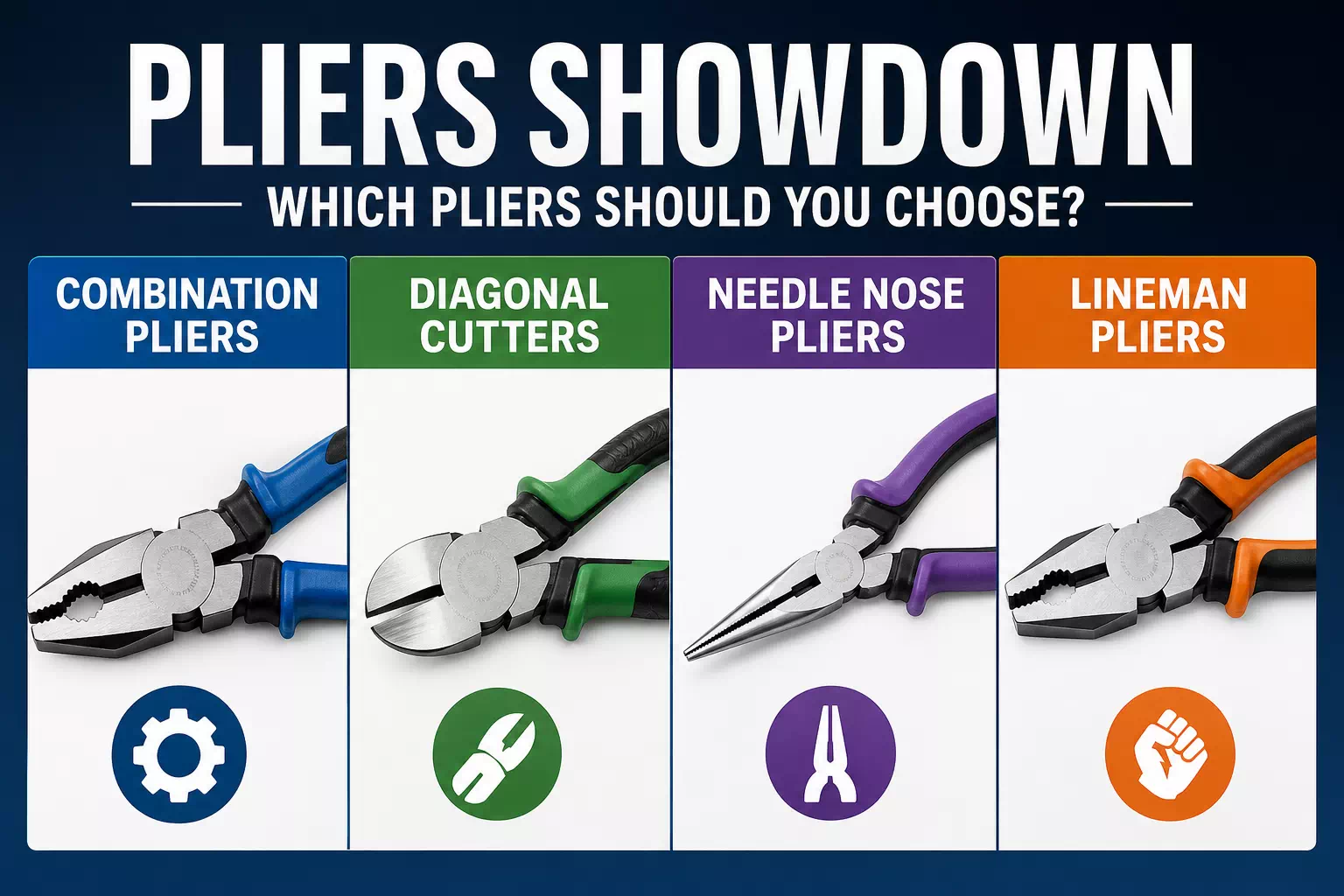
Combination pliers, diagonal cutters, needle nose pliers, and lineman pliers for electrical work.
Four Common Insulated Plier Types
Insulated combination pliers
Insulated combination pliers combine gripping jaws with cutting edges. They are useful for holding, bending, twisting, and light or medium wire cutting within the rated capacity.
They are a practical general-purpose choice for control panels, field service, and electrician kits. The limitation is access: the head is wider than a needle nose design and may not fit between closely spaced terminals.
Insulated diagonal cutters
Insulated diagonal cutters are designed mainly for cutting wire, pins, cable ties, and other materials within the manufacturer’s rating. Check the cut style, head shape, wire capacity, insulation, and access.
A slim head may reach a crowded terminal better. A high-leverage head may reduce hand force. These benefits do not always come in the same model. Cut straight across the wire and use eye protection where fragments may fly. CCOHS recommends cutting at right angles rather than rocking the tool .
Insulated needle nose pliers
Insulated needle nose pliers reach, hold, bend, and position small wires or components in confined spaces. They are useful around control terminals, connectors, relays, and electronic assemblies.
The narrow tips are not designed for heavy loads. Do not use them to bend large wire, pry parts apart, or twist fasteners. CCOHS warns that large-wire bending can damage needle nose tips . For electronic work, also check tip alignment and surface finish.
Insulated lineman pliers
Insulated lineman pliers, also called side-cutting lineman’s pliers, have a broad gripping area, strong pivot, and side-cutting edges. They are used for gripping, twisting, splicing, pulling, and cutting wire in electrical, communications, and construction work.
Their stronger head provides leverage but takes up more space. They may be suitable for larger conductors and the wrong choice inside a compact electronic enclosure. Check jaw width, handle length, wire capacity, insulation, and any limits on hardened wire or bolt cutting.
Which Type Should an Electrician Choose?
Work situation | Useful starting point |
Control-panel wiring | Insulated combination pliers, diagonal cutters, and needle nose pliers |
Distribution equipment | Insulated combination or lineman pliers plus suitable cutters |
Small electronic assemblies | Slim insulated needle nose pliers and precision cutters |
Field service | Compact insulated pliers set |
Larger conductors or construction wiring | Insulated lineman pliers and dedicated cutters |
Mechanical workshop work | Regular pliers selected for the material and load |
Dawei Metal’s device measurement and insulated tool guide describes a practical combination of needle nose pliers, combination pliers, side cutters, wire strippers, and other electrical tools.
Are Insulated Pliers Always Safer?
They are more appropriate than regular pliers when electrical exposure is possible, provided they are correctly rated, maintained, and used within the work procedure. They do not replace:
•De-energization and isolation
•Lockout or tagout where required
•Verification that the circuit is de-energized
•Appropriate PPE and meter selection
•Safe approach distances
•Training and supervision
If the task can be completed de-energized, follow that method instead of relying on insulated handles as the primary control.
Buying Checklist
Before purchasing insulated pliers, confirm:
1.Tool type: Combination pliers, diagonal cutters, needle nose pliers, lineman pliers, or another model.
2.Electrical documentation: Voltage marking, standard reference, model number, and relevant certificate or test report.
3.Mechanical specifications: Jaw length, overall length, cutter capacity, wire material, pivot design, and handle profile.
4.Handle condition and design: Stable grip, intact insulation, finger guards, and no sharp edges or gaps.
5.Sample consistency: For OEM or wholesale orders, check insulation, jaw alignment, cutting edges, markings, and packaging.
6.Application fit: Match the kit to panel work, distribution equipment, electronic assembly, field service, or mechanical maintenance.
For a larger electrical kit, review Dawei Metal’s VDE insulated electrician tool set with sockets, then confirm current configuration, certification, and packaging details with the supplier.
Common Mistakes
•Mistaking a colored or cushion-grip handle for tested electrical insulation
•Choosing insulation without checking jaw size and cutting capacity
•Using pliers as a wrench and damaging a nut
•Using diagonal cutters as gripping tools
•Forcing needle nose tips against heavy wire
•Cutting material harder or larger than the tool rating
•Keeping a tool with cracked insulation, loose pivots, chipped cutters, or distorted jaws in service
Inspection, Cleaning, and Storage
Inspect insulated pliers before every job. Look for cuts, cracks, punctures, deep scratches, swelling, peeling, exposed metal, and damage near the head, finger guards, and handle ends.
Check the working end too. The jaws should align correctly, the pivot should not be excessively loose, and cutters should not be chipped or rounded. Clean the tools with a soft cloth and a manufacturer-approved method. Avoid abrasive pads, wire brushes, aggressive solvents, and unapproved coatings.
Store insulated pliers in a fitted case or labeled pouch away from loose blades, drill bits, sharp metal, direct sunlight, excessive heat, and chemicals. If a tool is dropped, struck, exposed to an arc event, or trapped under equipment, remove it from service until it has been assessed.
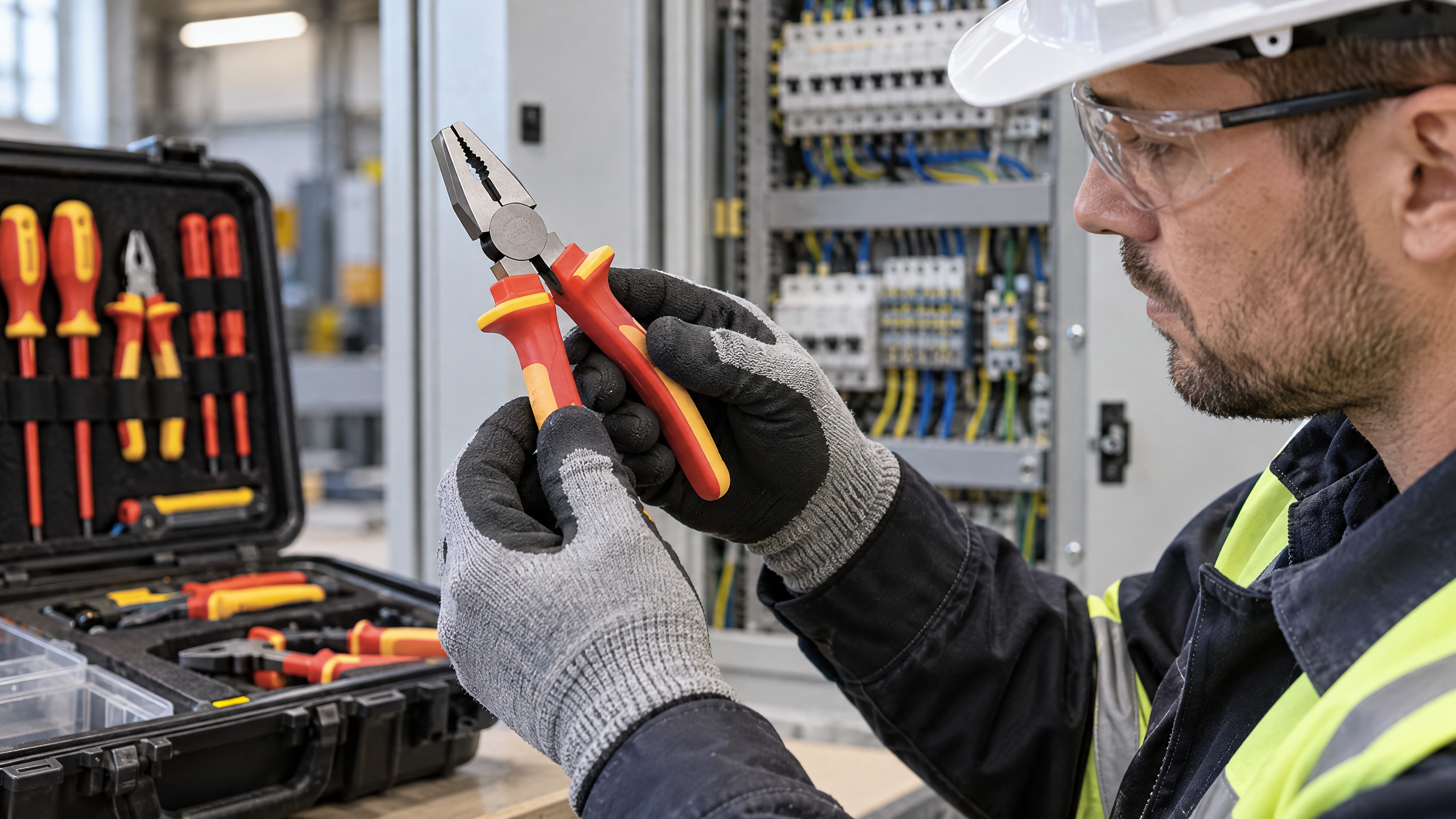
Inspect insulation, finger guards, pivots, jaws, and cutting edges before use.
Dawei Metal’s maintenance and storage guide for insulated tools provides a related inspection, cleaning, storage, and replacement routine.
Frequently Asked Questions
Are insulated pliers safer than regular pliers?
They are more appropriate near energized parts because they are designed with an insulating system and relevant markings. They are not a substitute for safe electrical procedures.
Can regular pliers be used for electrical work?
They may be suitable for de-energized mechanical tasks. They should not be treated as electrically protective tools near energized parts because the handles are plastic or rubberized.
What does 1000V on insulated pliers mean?
It is a voltage marking that must be interpreted with the applicable standard, AC/DC context, intended use, and product documentation. It does not authorize casual work on any 1000V equipment.
Are VDE pliers and IEC 60900 pliers the same?
The terms may overlap in product descriptions, but they are not automatically identical. Confirm the exact standard, certification, and model documentation.
Which insulated pliers should be in a basic electrician kit?
A common starting set is insulated combination pliers, insulated diagonal cutters, and insulated needle nose pliers. Add insulated lineman pliers for heavier conductors and construction work.
How often should insulated pliers be inspected?
Inspect them before each job and after any drop, impact, contamination event, or suspected damage. Formal inspection or dielectric testing should follow the applicable standard, employer program, manufacturer guidance, and local requirements.
Conclusion
Regular pliers are general mechanical tools. Insulated pliers add a purpose-designed insulating system, protective handle features, markings, and—where applicable—testing or certification information.
The four common types still have different jobs: combination pliers grip and handle general work, diagonal cutters cut, needle nose pliers reach tight spaces, and lineman pliers provide stronger grip and leverage.
Choose the mechanical profile for the work, then verify the insulation, markings, documentation, and condition. Use insulated pliers as one part of a complete electrical safety procedure, not as a replacement for it.
Label:
- Pro:Combination Pliers vs. Diagonal Cutters, Needle Nose Pliers, and Lineman Pliers
- Next:Rolling Tool Chest with Tools:
Related News
Latest product
-
Rolling Tool Chest with Tools: How to Choose the Right Setup for Your Workshop
-
Insulated Pliers vs. Regular Pliers: What Is the Difference?
-
Combination Pliers vs. Diagonal Cutters, Needle Nose Pliers, and Lineman Pliers
-
Torque Screwdrivers, Wire Strippers, Torque Drivers, and Nut Drivers: A Practical Electronic Tooling
-
How to Choose a Rolling Tool Cabinet: 6 Drawers or 17?
-
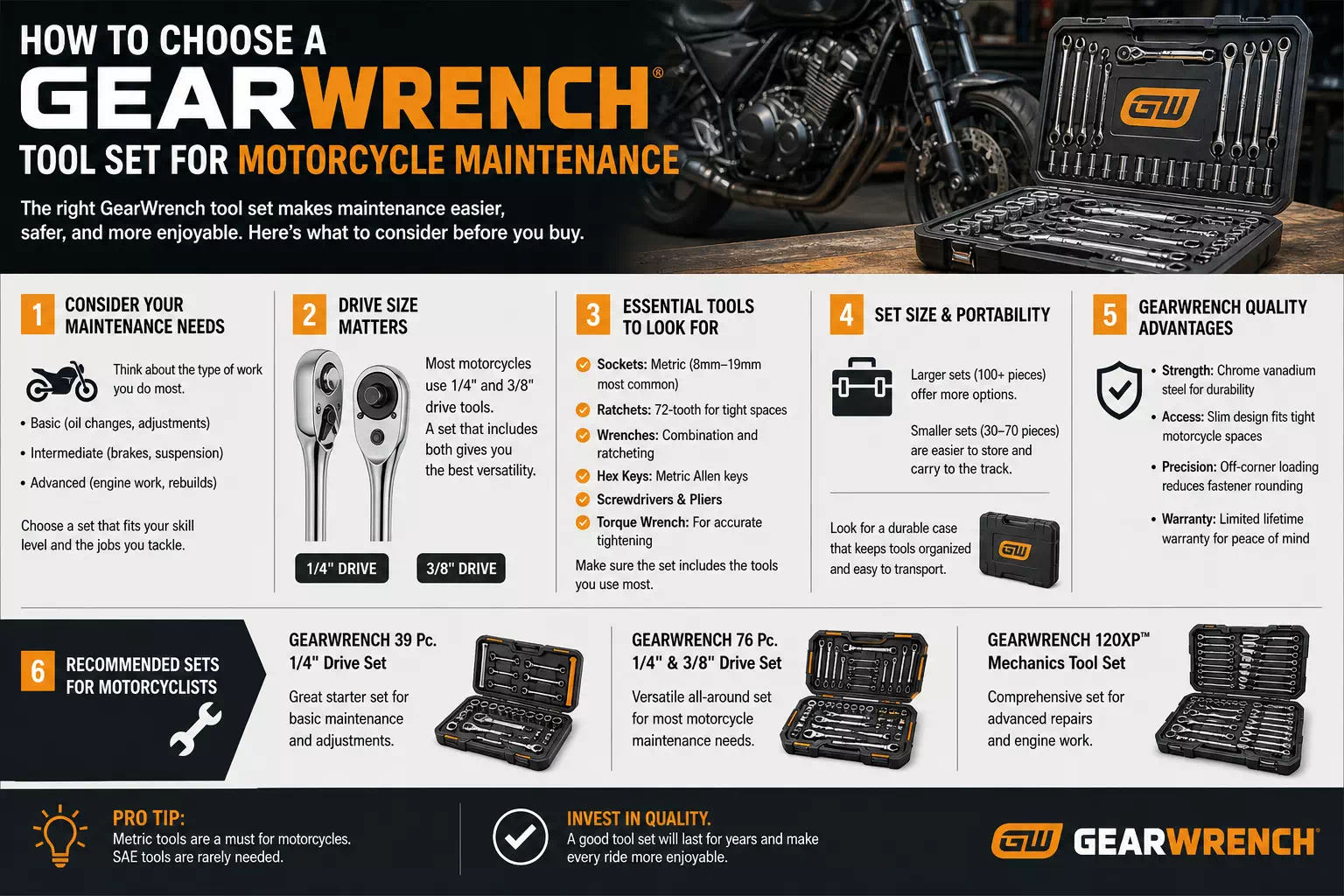
How to Choose a Gear Wrench Tool Set for Motorcycle Maintenance