Service Hotline:

+8615666285386
Blog
Hot News
Contact Us

Company:Shandong Dawei Metal Materials Co., Ltd.

Tel:+8615666285386

Email:dwhardwaretools@gmail.com

Address:Room 1413, Building 8, Shandong Steel Xintiandi Plaza, No. 61 Gongye South Road, High-tech Zone, Jinan City

Blog

Insulated Tools: The Complete 2026 Guide to VDE 1000V Safety & Buying

Author:Editor Click: Release date:2026-08-13 14:48
An insulated tool is easy to recognize in a catalogue. Choosing one responsibly takes more than recognizing a coloured handle or a “1000V” mark.
For an electrician, a maintenance supervisor, or a buyer building a tool range, the useful questions are straightforward: what work will the tool do, what exact claim is required, and how can that claim be checked for the model being purchased? That order matters. It keeps the decision tied to the task rather than to a label, a price point, or a product photo.
This guide explains how to assess insulated hand tools for electrical work, how to read common ratings and marks, and how to specify a practical set without making safety claims that the paperwork cannot support. It is written for professional users and B2B buyers, but the same checks are valuable for anyone selecting tools used near electrical equipment.
Important: An insulated tool is one part of an electrical-safety system. It does not replace isolation, verification of absence of voltage, job authorization, personal protective equipment, training, or the safe working method required at the site. IEC 60900 itself states that the covered tools contribute to safety when they are used by skilled persons in accordance with safe methods of work and applicable instructions.

Start with the job, not the set size

A 25-piece case can be a good fit for one crew and an inconvenient collection of unused tools for another. Before comparing brands, list the fastening, gripping, cutting, and access tasks that occur at the actual worksite.
For panel assembly and routine control-cabinet work, screwdrivers in the right tip profiles and sizes usually come first. A long-nose pliers, combination pliers, diagonal cutters, and a compact wire stripper may be more useful than a large collection of sockets. For switchgear, busbar, or larger fastening points, insulated sockets, a ratchet, extensions, and correctly sized wrenches may be the priority. Cable work raises a different question again: cutting capacity and tool geometry must match the conductor and the available clearance.
Typical work situation
Tools commonly considered first
What to verify before ordering
Terminal blocks, switches, and control cabinets
Slotted and Phillips screwdrivers; long-nose and combination pliers
Tip sizes, blade length, clearance around terminals, and the exact voltage/standard claim required by the job
Panel maintenance and larger fastening points
Insulated sockets, ratchet, extensions, adjustable or fixed-size wrenches
Drive size, socket range, access depth, torque requirements, and model-specific documents
Cable preparation and installation
Cable cutter, wire stripper, gripping pliers, screwdrivers
Cable capacity, tool dimensions, cutting performance, and whether the tool is intended for the electrical task
Distributor or private-label programme
A balanced group of core hand tools with a durable case
Target-market compliance needs, exact model list, packaging, replacement parts, and document traceability
This approach also prevents a common buying mistake: treating the word insulated as if it describes every part of a tool’s performance. Insulation may be critical, but it does not tell you whether a screwdriver tip fits a terminal, whether a cutter handles the cable size in question, or whether a socket can reach the fastener without crowding nearby components.
For a more detailed tool-by-tool selection discussion, see . The point is not to buy every available tool. It is to choose the smallest set that covers the work safely and repeatably.

What a 1000V marking does — and does not — tell you

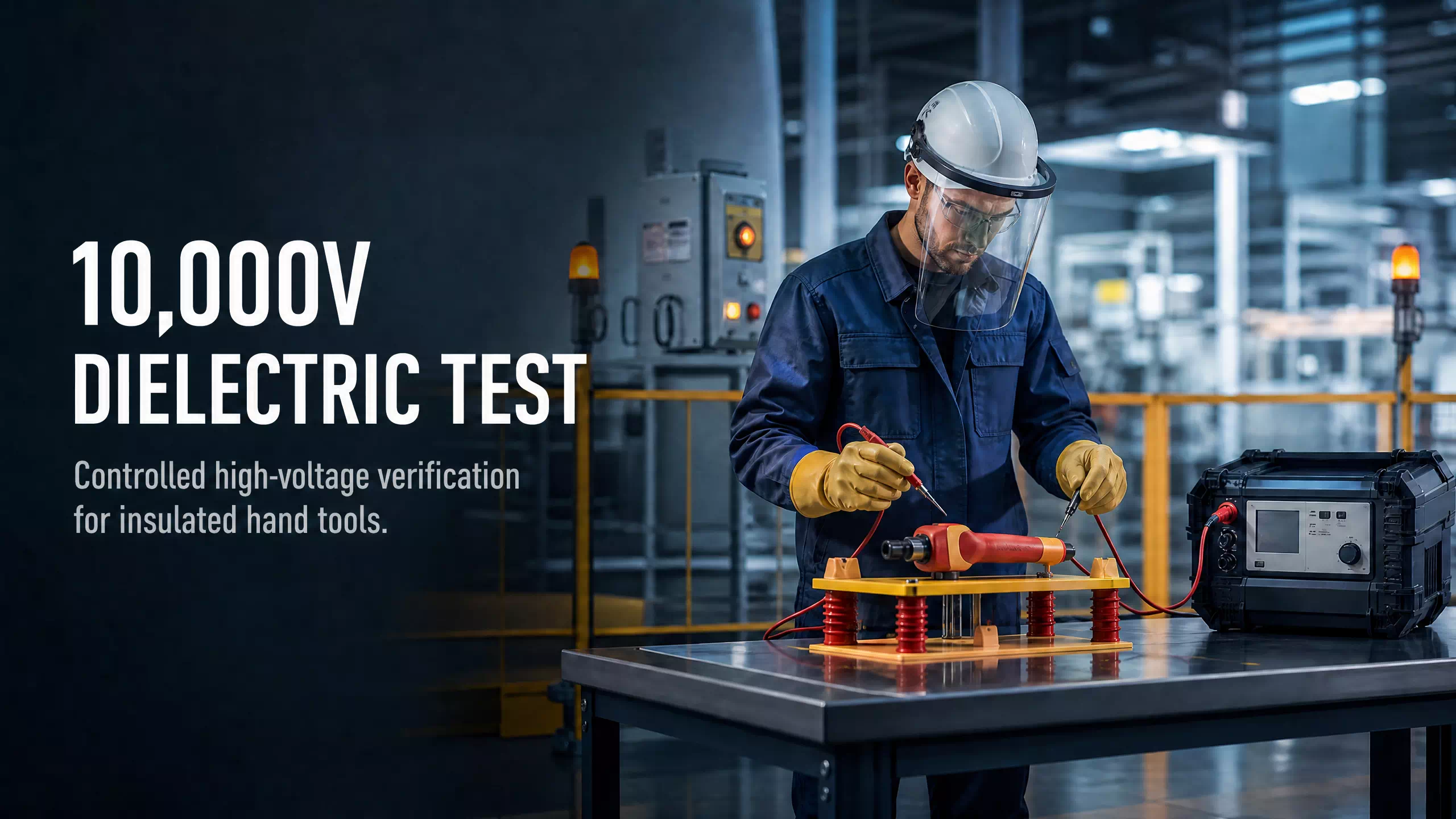
The most widely referenced international standard in this area is IEC 60900:2018, Live working — Hand tools for use up to 1,000 V AC and 1,500 V DC. Its published scope covers insulated, insulating, and hybrid hand tools used for work on or close to live parts at those nominal voltages.
That scope helps explain why a 1000V mark deserves attention, but it should not be read as a blanket permission to work on an energized circuit. The marking relates to a tool and its stated use; it does not assess the condition of the electrical installation, the user’s authorization, the presence of stored energy, the weather, the work method, or the personal protective equipment required for the job.

The terms below are often used together, yet they answer different questions.
01-dielectric-test-10000v.webp


Term on a listing or tool
What it can indicate
What still needs checking
1000V AC / 1500V DC
A claimed nominal-voltage category consistent with the IEC 60900 scope
Whether the claim applies to the exact model, and whether the tool is undamaged and suitable for the task
IEC 60900
The standard referenced by the product claim
The current supporting documentation, model number, scope, and any market-specific requirement
VDE mark or VDE certification claim
A claim of third-party certification within the VDE system
The precise certificate and the product models it covers; a mark should never be assumed to cover a different configuration
Test report
Evidence that a particular product or sample was tested under stated conditions
Whether it is current, applicable to the purchased configuration, and sufficient for the buyer’s compliance requirement
VDE is not another name for IEC 60900. IEC 60900 is a standard; VDE is an independent testing and certification organization with certification marks. VDE explains that the award of its marks follows manufacturing-facility controls, product inspections, and regular production monitoring. For a procurement team, that distinction is practical: a standards reference, a certificate, and a supplier’s product description should agree on the same manufacturer, model, and applicable claim.
Do not infer certification from colour, wording, or a similar-looking product. If a tender, distributor, or jobsite requires a particular standard or certification, ask for the supporting document before placing the order. Then compare the manufacturer name, model number, tool range, issue status, and conditions of use with the tools on the quotation.

Choose the individual tools that do the real work

A set is only as useful as its most-used tools. For many electrical tasks, the first tools to evaluate are insulated screwdrivers. Look for the tip profiles required by the equipment in your market, then check that the blade length and diameter suit the working space. A correctly sized tip helps the user keep control at the fastener; a poor fit invites slipping and damaged screw heads.
If screwdrivers are the centre of the set, the detailed selection guide on is a useful companion. It covers common slotted and Phillips sizes, practical set composition, and the questions buyers should put to a supplier.
Pliers deserve the same level of attention. Long-nose pliers are chosen for reach and component handling. Combination pliers are used for gripping and general hand work. Diagonal cutters and cable cutters should be selected according to the material and size they are expected to cut. Their insulation claim does not make every cutting task appropriate; the required cutting capacity and the risk controls for the work remain separate decisions.

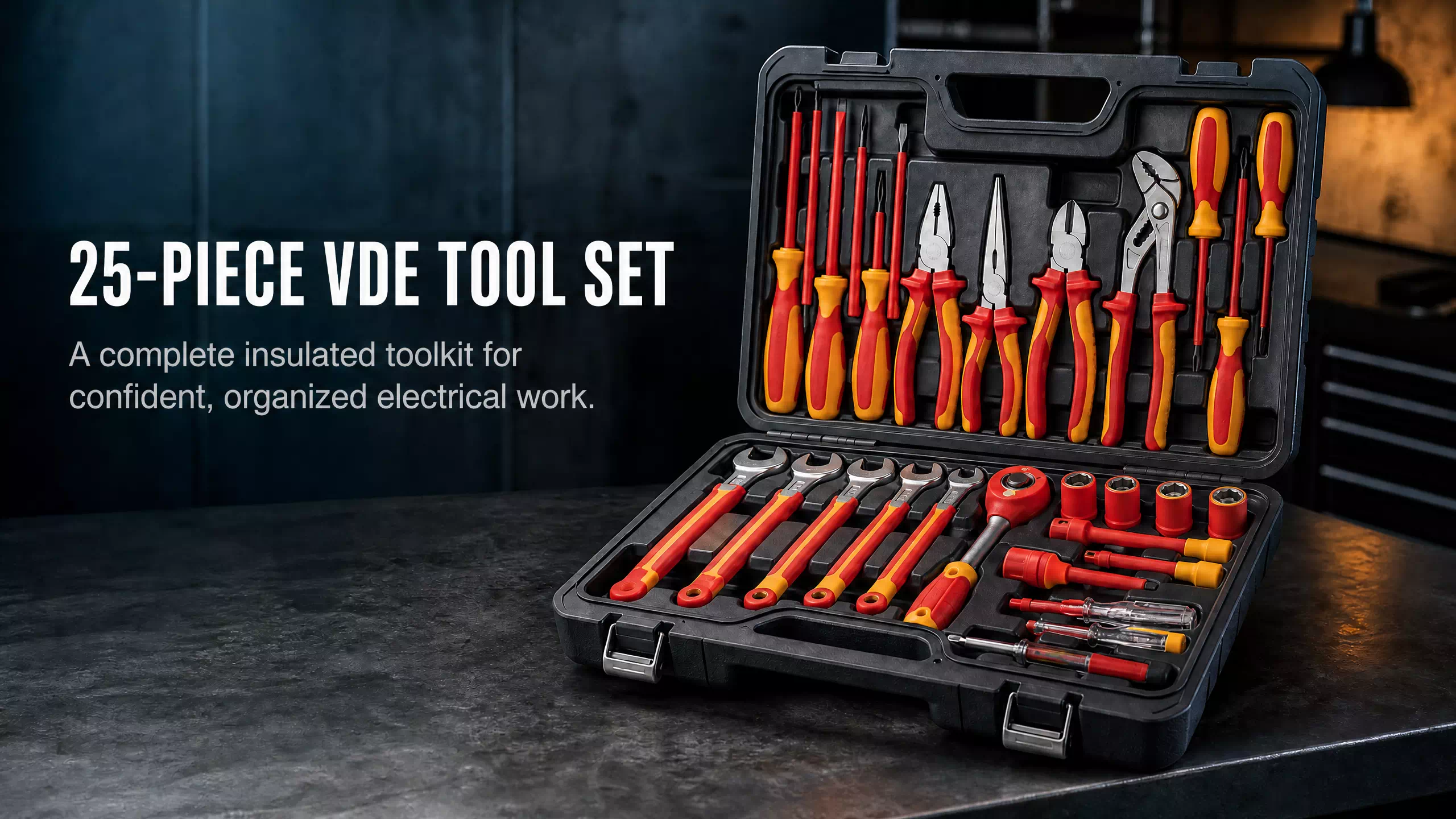
Wrenches, sockets, ratchets, and extensions are sometimes overlooked in basic kits, yet they can be essential in panels and industrial maintenance where terminals, lugs, and enclosure hardware must be reached without bringing bare metal tools close to adjacent parts. Check the drive size, socket range, extension length, and case layout as carefully as you check the number of pieces.
03-vde-tool-set.webp


Ask for documents before you compare prices

For an occasional user, it is tempting to compare only the number of tools and the unit price. For a professional buyer, the more useful comparison starts with documents and traceability. A lower price is not automatically a problem; an unanswerable question about the tool’s identity or claimed standard is.
Use the following sequence when requesting quotations.
1.Define the intended application. State the work environment, the tool categories, the voltage category or standard required by the project, and any market-specific compliance conditions. This gives the supplier a clear brief and avoids vague “VDE tool set” requests.
2.Request the exact configuration. Ask for a complete item list with model numbers, sizes, drive sizes, materials where relevant, packaging, and photographs. A certificate or test report cannot reliably support a kit that has been changed without the documentation changing with it.
3.Match documents to models. When a standard or certification claim is important, request the official certificate or test documentation and compare its scope with the quoted models. Clarify who issued it, when it was issued, and whether it applies to the branded or customized version being ordered.
4.Review a sample as a working tool. Check the tool feel, the fit of screwdriver tips, the smoothness of pivots, the clarity of markings, the case arrangement, and whether the selected sizes match the intended work. A sample is where practical usability becomes visible.
5.Record the approved version. Once the set is agreed, keep the approved tool list, artwork, documents, and sample reference together. This is particularly important where labels, packaging, or private-brand specifications are involved.
The right evidence will vary by market and use case. VDE’s published service scope includes tests for hand tools used up to 1,000V AC and 1,500V DC under DIN EN IEC 60900, alongside electrical, mechanical, and thermal considerations for live-working tools. That is a useful reminder that a serious tool specification is more than a headline voltage number.

Inspect tools before electrical work

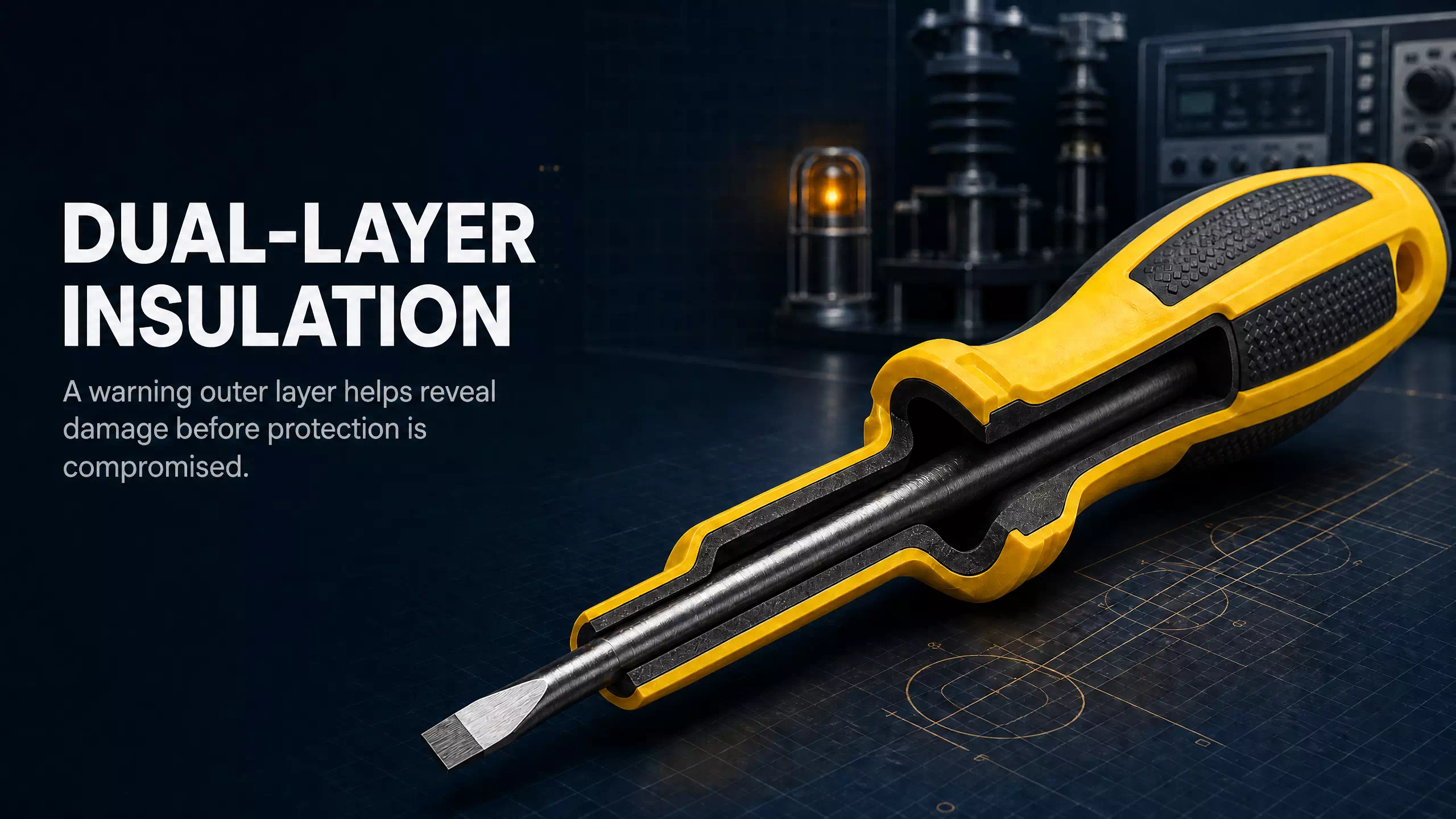
A good tool can become unsuitable through everyday use. The inspection does not need to be complicated, but it needs to be deliberate. Look at the working end, the insulated areas, the transition between insulation and metal, and the handle surface before the tool goes near electrical equipment.
02-dual-layer-cutaway.webp


What you find
Sensible response
Cut, crack, chip, split, or loosened insulation
Remove the tool from electrical service and follow the manufacturer’s instructions and the site procedure for replacement or assessment.
Tool has been dropped, overheated, exposed to chemicals, or heavily contaminated
Do not assume the insulation remains suitable. Clean and assess it under the manufacturer’s instructions and the employer’s safety procedure before reuse.
Worn screwdriver tip, damaged cutter edge, bent shaft, or loose pivot
Replace or service the tool as appropriate. Mechanical control at the point of work is part of safe use.
Marking cannot be read or no longer matches available documentation
Treat the claim as unverified until the correct model information and supporting documents are confirmed.
Store insulated tools in a clean, dry case or tray rather than loose among sharp, heavy tools. Keep them apart from tools intended only for general repair, especially where crews work quickly and a tool may be selected by feel. Most importantly, do not modify the insulation, use a screwdriver as a pry bar, or continue with a damaged tool because it still turns a screw.

A practical option for a mixed electrical-maintenance kit

Some maintenance teams need both screwdrivers and a larger socket range in one portable case. The published is one example of that layout: its product page lists 1/2-inch insulated sockets from 10 mm to 32 mm, a ratchet, extension bars, slotted and Phillips screwdrivers, pliers, an adjustable wrench, and a carry case.
The same page makes an important qualification that buyers should apply to any comparable product: claims relating to VDE 1000V or IEC 60900 must be confirmed with the official certificate before they are used in marketing or relied upon for live electrical work. That is not a minor footnote. It is the correct final check between a useful product configuration and a verified compliance claim.

Frequently asked questions

Are insulated tools only for live work?

No. They are often selected for work on or near electrical equipment because they provide an additional layer of protection when used as intended. However, insulating tools do not turn routine work into authorized live work. De-energize whenever possible and follow the governing site procedure.

Is a 1000V mark enough for a professional purchase?

Not when the job, contract, or market requires a documented standard or certification. Confirm the exact model, its claimed scope, and the supporting documentation. The marking, the quotation, and the certificate should describe the same product.

What should be in an insulated electrician tool set?

Start with the work. Terminal and control work often calls for the correct screwdriver sizes and a small selection of pliers. Larger maintenance tasks may require sockets, a ratchet, extensions, and wrenches. Select cable tools by capacity rather than by appearance or piece count.

Can a damaged insulated tool still be used for ordinary work?

The answer depends on the tool condition, the manufacturer’s guidance, and the work procedure. It should not remain in electrical service with compromised insulation. Do not keep it in a way that allows it to be mistaken for an approved insulated tool.

What should an importer ask a supplier?

Ask for an exact bill of materials, model references, product specifications, required standard or certification documents, a sample, packaging details, and the process for keeping the approved configuration consistent in production. If the buyer’s brand will appear on the product, clarify the documentation and marking requirements before artwork is finalized.

The bottom line

The most reliable way to buy insulated tools is also the least dramatic: define the task, choose the tools that fit it, confirm the exact claim with the right documents, and inspect the tools every time they are put to electrical use.
That process serves both sides of a purchase. Electricians and maintenance teams get tools that fit their work. Distributors and importers gain a clearer specification for samples, documents, and product positioning. And neither group has to rely on a coloured handle or an unverified label to make a safety decision.

If you are sourcing a practical insulated tool configuration for distribution, OEM packaging, or a maintenance programme, with the intended application, target market, and required documents. A clear specification at the start makes a useful quotation possible.

References

[1] IEC 60900:2018 — Live working: Hand tools for use up to 1,000 V AC and 1,500 V DC
[2] VDE Institute — Certification Marks and Attestations
[3] VDE Institute — Tools for live working
Label:
Related News
Latest product