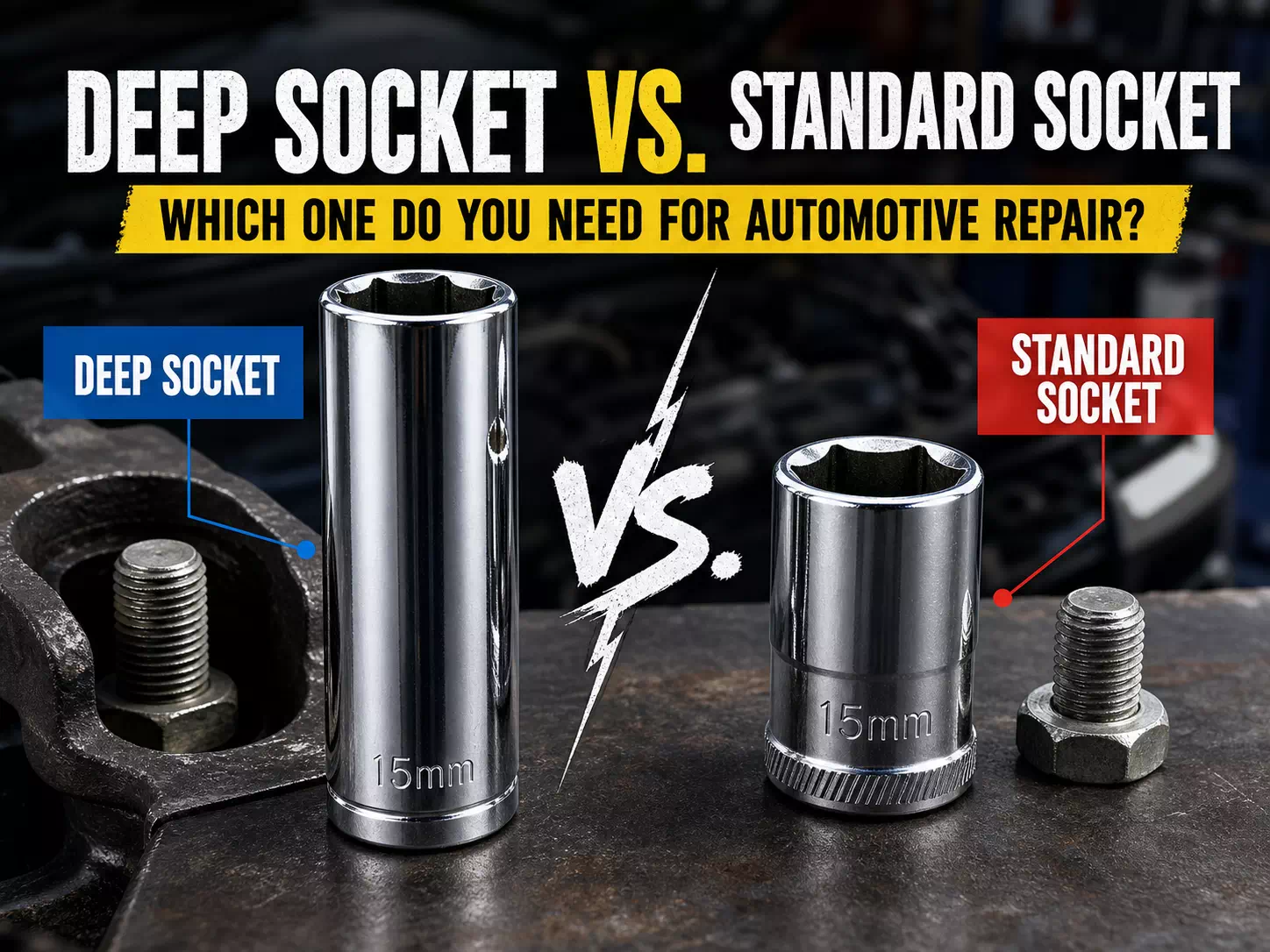
When comparing deep socket vs standard socket, the difference is mainly the length of the working body. A standard socket, also called a shallow socket, has a shorter body and is useful when the fastener is close to the surface or when clearance is limited. A deep socket extends farther over the fastener and provides additional internal space for exposed threads or recessed fasteners.
Neither type is a universal replacement for the other. Standard sockets are generally more convenient in tight spaces, while deep sockets become important when a nut sits on a long threaded stud or when the fastener is positioned below an obstruction.
What Is a Standard Socket?
A standard socket has a relatively short working body between the drive end and the opening that fits over the fastener. Its compact length makes it easier to use in crowded areas where a longer socket could contact a bracket, hose, cover or nearby component.
Standard sockets are a practical choice for many general maintenance jobs. They work well when the nut or bolt head is fully exposed and there is no long section of thread that needs to pass inside the socket.
Engine brackets, covers, clamps and many underbody fasteners can often be handled with a standard socket when the surrounding clearance is adequate.
The shorter body also reduces the overall height of the tool assembly. This can matter when a ratchet needs to stay below a hood, crossmember, body panel or other obstruction.
The main limitation is socket depth. If a threaded stud extends significantly beyond the nut, the socket may bottom out on the stud before it fully engages the fastener. When this happens, the drive tool may appear connected while the socket is not properly seated.
That is a clear indication that you need a deep socket.
What Is a Deep Socket?
A deep socket has a longer body that allows it to extend farther over a nut, bolt or threaded stud. The additional internal depth provides clearance for thread that projects beyond the fastener.
This design is particularly useful for nuts installed on studs. Wheel-related fasteners, suspension components, engine-bay mounts and some exhaust or chassis fittings can have more exposed thread than a standard socket can accommodate.
A deep socket allows the nut to sit farther inside the socket while the drive end remains fully connected to the ratchet or extension.
Deep sockets can also help when a fastener is recessed or positioned below a surrounding surface. The extra length may allow the socket to reach the fastener while keeping the ratchet away from the surrounding component.
However, a longer socket is not automatically better. If the surrounding space is narrow, the extra body length can make alignment difficult or prevent the socket from entering the opening.
The socket should always be fully seated on the fastener before force is applied. If it is held at an angle or only partially covers the fastener, the risk of slipping or damaging the fastener increases.
Deep Socket vs. Standard Socket: Key Differences
The two socket types normally share the same drive size and fastener size. The main difference is the length of the working body, and that difference affects access, clearance and the types of fasteners each socket can handle.
| Feature | Standard Socket | Deep Socket |
|---|---|---|
| Body length | Shorter and more compact | Longer with greater internal depth |
| Best use | Exposed fasteners and tight vertical clearance | Long studs, recessed nuts and extended threads |
| Clearance requirement | Usually needs less space | Needs more room for the longer body |
| Risk of bottoming on a stud | Higher when the thread is long | Lower because the socket extends farther over the thread |
| Access around obstructions | Often better in crowded spaces | Can be better when the fastener sits below an obstruction |
| Storage | Takes less space | Takes more space and should be clearly identified |
This comparison is not about strength alone. A deep socket is not automatically stronger, and a standard socket is not automatically weaker. Strength depends on the steel, heat treatment, wall design, drive connection, manufacturing quality and whether the socket is intended for hand or impact use.
When Should You Use a Standard Socket?
Use a standard socket when the fastener is accessible and the nut does not need extra internal depth. In these conditions, the shorter tool is often easier to control and less likely to collide with nearby parts.
Tight Engine-Bay Positions
Engine compartments rarely provide more room than necessary. A fastener may be easy to see but difficult to approach because of a hose, wiring harness, bracket or cover.
The compact shape of a standard socket can help the ratchet stay closer to the fastener and avoid surrounding components.
This is common when working on brackets, covers, accessory mounts and small support hardware. When the nut is not sitting on a long stud, additional socket length may provide little practical benefit.
Low-Clearance Work
A standard socket is useful when there is limited space above the fastener. A ratchet and socket may need to fit under a panel or between a component and the vehicle body.
The shorter assembly can leave more room for the tool to move through the available angle.
A low-clearance problem cannot always be solved simply by choosing a shorter socket. The ratchet head, extension and drive angle also matter.
If the fastener is recessed, a short extension may provide better control than a deep socket. Choose the combination that keeps the socket straight and fully engaged.
Fasteners Close to a Flat Surface
When a bolt head or nut sits directly against a flat mounting surface, a standard socket is usually sufficient. The socket only needs to cover the fastener head.
A deep socket offers little additional benefit unless the fastener is recessed or the surrounding structure prevents normal access.
When Is a Deep Socket the Better Choice?
A deep socket is the better choice when a standard socket cannot reach the fastener properly or cannot pass over the exposed thread.
Nuts on Long Threaded Studs
This is one of the most common reasons to use a deep socket.
As a nut is loosened, more of the stud extends above it. A standard socket may bottom out on the stud before the socket has fully engaged the nut.
A deep socket provides additional room for the stud inside the socket body. It keeps the drive connection engaged while the socket surrounds the nut.
If a nut starts on a long stud, check the socket depth before applying high force.
Recessed Nuts
Some fasteners sit inside a bore, channel, bracket or other recessed area. A standard socket may not extend far enough to reach the nut, especially when the ratchet head needs to remain outside the recess.
A deep socket can bridge that distance and maintain contact with the fastener.
The surrounding opening must still be large enough for the socket body. A deep socket only helps if its outside diameter fits through the available space.
For narrow recesses, a thin-wall or specialty socket may be more appropriate than simply choosing a deeper socket.
Wheel and Suspension Work
Wheel studs and suspension assemblies often create situations where socket depth matters. A nut may be positioned on a stud, behind a bracket or below a surrounding component.
For this reason, deep sockets are commonly included in an automotive socket set.
Do not assume that every wheel or suspension fastener should be handled with a deep socket. Check the available clearance and the vehicle service procedure.
Some locations require a thin-wall socket, special profile or impact-rated socket rather than a standard chrome deep socket.
Spark-Plug Service
Spark-plug sockets are a special category rather than ordinary deep sockets. They are designed to reach the plug and usually include a retaining insert or another feature to hold the spark plug during removal and installation.
A general-purpose deep socket should not automatically be used as a substitute for a spark-plug socket.
The same principle applies to other specialty fasteners. Extra length is only one part of the design. The working profile, wall thickness, retention method and drive rating must match the job.
Can a Deep Socket Replace a Standard Socket?
Not in a complete automotive setup.
A deep socket can handle some jobs that would normally be performed with a standard socket, but it requires more clearance around and above the fastener.
A longer socket may contact a nearby bracket or prevent the ratchet from sitting in the correct position. It can also make it harder to work in a shallow space under a vehicle component.
The reverse limitation is more important. A standard socket cannot reliably replace a deep socket when the stud reaches the closed end of the socket before the nut is fully engaged.
Do not modify a standard socket by removing its internal obstruction or use an extension as an improvised solution. Select a socket with sufficient internal depth for the application.
For a home garage, a compact set of standard sockets plus deep sockets in commonly used sizes is usually more useful than a large set containing only one type.
For a repair shop, both types should be organized by drive size and clearly marked.
Hand Sockets vs. Impact Sockets
Socket depth is only one selection decision. The socket must also be rated for the tool that will drive it.
Chrome-finished sockets designed for hand ratchets are intended for controlled hand use. Impact sockets are designed to tolerate the shock and vibration produced by an impact wrench.
When using an impact wrench, choose a deep or standard socket specifically marked for impact service. Use the correct retaining pin and ring when required by the tool manufacturer.
Do not assume that a chrome hand socket is safe simply because it fits the impact-wrench drive.
The same caution applies to extensions and adapters. An impact-rated socket connected to a non-rated accessory may still create a weak point in the tool chain.
Always follow the manufacturer's instructions for the complete setup.
Choosing the Right Drive Size
Drive size affects the capacity and working space of the socket assembly. The best drive size depends on the fastener range and repair tasks, not simply on whether the socket is deep or standard.
| Drive Size | Common Automotive Work | Typical Advantage |
|---|---|---|
| 1/4-inch | Interior components, small brackets, sensors and small fasteners | Compact access and good control |
| 3/8-inch | General engine-bay work, accessories, brackets and routine service | Versatile coverage for many repairs |
| 1/2-inch | Wheels, suspension, chassis, hubs and larger fasteners | Higher capacity for larger sockets and force |
A 3/8-inch drive is often a practical starting point for general car maintenance. Add 1/4-inch tools when access is tight and the fasteners are small. Add 1/2-inch tools when the work involves larger fasteners or higher breakaway force.
The drive size does not determine whether a socket is deep or standard. Both types are available in the same drive families.
How to Choose a Socket Set
Start with the vehicles and repairs the set must cover. A workshop servicing passenger cars may prioritize common metric sizes and 3/8-inch drive tools. A mixed fleet or industrial maintenance department may need both metric and SAE coverage, larger drives and specialty sockets.
Check the Actual Size Coverage
Do not judge a set only by its piece count. A kit may contain many bits and adapters while offering limited coverage in the socket sizes used most often.
Check the size range for both standard and deep sockets.
If a product lists “deep sockets included,” verify exactly which sizes are deep. Some kits include deep sockets only in a small selection of common sizes.
That may be adequate for a home garage, but a professional repair shop should compare the full working range.
Check the Socket Profile
Six-point sockets generally provide strong contact with the flats of a six-sided fastener. Twelve-point sockets offer more starting positions when the working angle is limited.
The right choice depends on access, fastener condition and the amount of force required.
For damaged, corroded or tightly secured fasteners, prioritize full engagement and the correct size. A socket that is close in size is not a substitute for the correct socket.
Separate Metric and SAE Tools
Metric and SAE sizes can appear similar, but they are not interchangeable.
Using an almost-fitting socket can damage the fastener and make removal more difficult. A workshop that handles different vehicle types should keep the two systems separated in the case or storage tray.
Consider Outside Diameter and Replacement Support
A deep socket may have enough internal depth but still be too wide for the recess. Compare the outside diameter and profile as well as the depth when the set will be used around wheel components, suspension brackets or recessed engine fasteners.
For professional use, confirm whether high-use sizes can be replaced individually. Replacing one socket is more practical than buying an entire new set because a single piece is missing.
Choosing a Complete Mechanic Tool Set
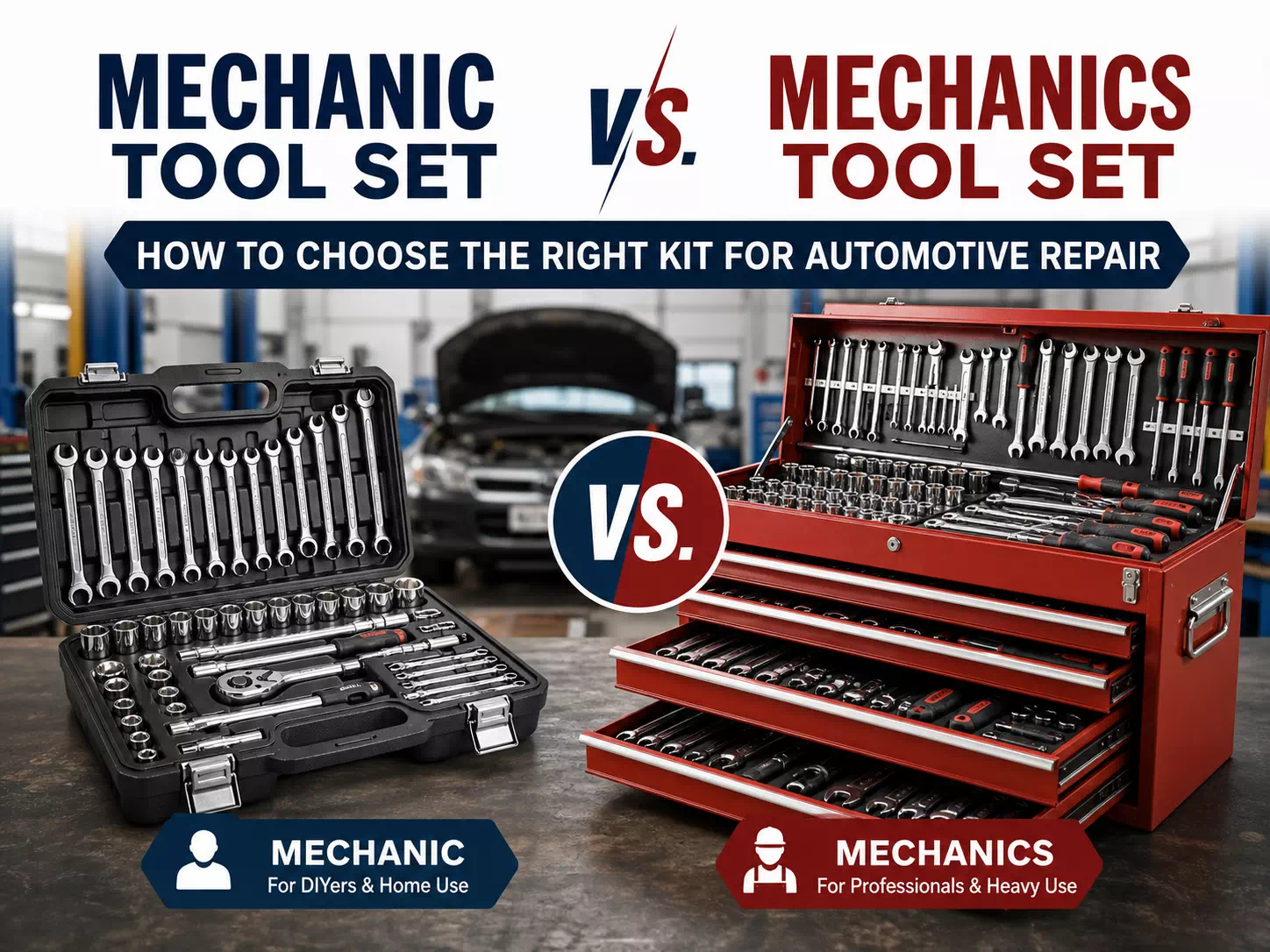
If you are setting up a workshop rather than buying a single socket, a complete mechanic tool set can provide a more organized combination of sockets, ratchets and other workshop tools.
For buyers looking for a multi-drive configuration, you can review Dawei's 94-piece socket and ratchet wrench set to compare coverage across 1/4-inch, 3/8-inch and 1/2-inch drive sizes.
If your workshop requires different socket and ratchet configurations, the professional socket wrench set collection provides another option for comparing complete tool configurations.
For customers who need a broader automotive hand-tool package containing sockets, wrenches, pliers, a hammer and screwdrivers, see the hand tool set for automotive repair.
If you are still deciding how many tools and drive sizes your workshop needs, the mechanic tool set buying guide provides a useful reference for comparing drive sizes, storage, materials and overall tool coverage.
Common Mistakes to Avoid
Buying Only Standard Sockets
A set can look complete and still leave you without the depth needed for long studs.
Check deep-socket coverage before deciding that a set is suitable for automotive work.
Buying Only Deep Sockets
Deep sockets are not a solution for every tight space. Their longer bodies can interfere with nearby parts and may not fit where a standard socket works easily.
A mixed set is more practical for most automotive applications.
Using the Wrong Size Because It Is Nearby
A socket that is almost the right size can round the fastener, especially when force is applied with a long handle or impact tool.
Stop and confirm the size whenever the fit is uncertain.
Applying High Force to a Poorly Seated Socket
Before loosening a tight fastener, check that the socket is fully seated, aligned with the fastener and appropriate for the drive tool.
If the socket is bottoming on a stud or held at an angle, change the tool before applying more force.
Treating Socket Depth as a Torque Specification
Socket depth does not determine the correct tightening torque. Use the vehicle manufacturer's specification and a suitable calibrated torque wrench when torque accuracy matters.
A ratchet or impact wrench should not replace the specified final-torque procedure.
A Practical Starting Configuration
| User | Practical Starting Configuration | What to Prioritize |
|---|---|---|
| Home Garage | 3/8-inch metric standard and deep sockets with ratchet and extensions | Common sizes, compact storage and replacement availability |
| Mobile Technician | Compact 1/4-inch and 3/8-inch mixed-depth set | Weight, case layout and frequently used sizes |
| Automotive Repair Shop | 1/4-inch, 3/8-inch and 1/2-inch drives with broad depth coverage | Daily access, durability, impact options and replacements |
| Fleet Maintenance Team | Standardized metric coverage plus selected SAE tools where required | Consistency across vehicles and inventory control |
| Heavy-Duty Repair | Larger drive sizes, deep impact sockets and specialist profiles | Capacity, safe handling and application-specific tools |
A smaller set with the correct sizes and both socket depths is often more useful than a larger case filled with duplicates.
Storage and Inspection
Keep standard and deep sockets separated or clearly labeled. Group them by drive size and then arrange the fastener sizes in order. This makes it easier to identify a missing socket before the next repair begins.
Inspect sockets for cracks, distorted drive openings, damaged corners, heavy corrosion and signs of impact damage. A socket that no longer fits the fastener cleanly should be removed from service rather than kept because it is still physically present in the case.
After working on a vehicle, account for sockets, extensions, adapters and universal joints. A final check of the engine bay and underbody can help prevent a tool from being left in a moving or hot area.
Frequently Asked Questions
Are deep sockets stronger than standard sockets?
Not necessarily. Strength depends on the material, heat treatment, wall design, drive connection and intended use. A deep socket is longer, not automatically stronger. Choose an impact-rated version when using an impact wrench.
Do deep sockets fit the same ratchets as standard sockets?
Yes, when the drive size is the same. For example, a 3/8-inch deep socket fits a 3/8-inch ratchet or extension. Fastener size and drive size are separate specifications, so check both before purchasing.
Can I use a deep socket for a wheel lug nut?
You can use one when the socket fits the wheel opening and is rated for the tool being used. If an impact wrench is involved, use an impact-rated socket. Some wheels require a thin-wall design or protective sleeve.
Are deep sockets necessary for a home garage?
They are not needed for every repair, but they are useful for long studs, recessed nuts and certain suspension or wheel-related fasteners. A small selection in common sizes can prevent a repair from stopping when a standard socket bottoms out.
Is a shallow socket the same as a standard socket?
In most tool catalogs, yes. “Shallow socket” and “standard socket” usually describe the shorter design. Product terminology can vary, so compare the actual dimensions when socket depth is important.
Should I buy a complete set or individual deep sockets?
Buy a complete set when you need basic coverage across multiple sizes. Buy individual deep sockets when you already have a good standard set and only need to fill specific gaps. For workshop use, confirm that individual replacement pieces are available.
Conclusion
The difference between a deep socket and a standard socket is straightforward, but it directly affects whether the tool can reach and fully engage the fastener.
Standard sockets are compact and effective in tight, exposed positions. Deep sockets provide the internal clearance needed for long studs and recessed fasteners. One type cannot reliably replace the other across all automotive repairs.
For a home garage, a 3/8-inch set containing both standard and deep metric sockets is a practical starting point. A professional workshop will usually need wider coverage across 1/4-inch, 3/8-inch and 1/2-inch drives, along with impact-rated sockets and task-specific designs.
Choose by working conditions rather than piece count. Check socket depth, drive size, fastener coverage, wall profile, impact rating, storage and replacement options.
When the socket is fully seated and matched to the job, the tool works more efficiently and the fastener is less likely to be damaged.
Looking for Deep Socket Sets or Automotive Hand Tools?
Dawei Metal supplies socket sets, mechanic tool sets, wrench sets and automotive hand tools for professional workshops, distributors, wholesalers and international buyers.
If you are sourcing a deep socket set, standard socket set, automotive socket set or complete mechanic tool set, send us your required drive sizes, socket sizes, piece count, packaging requirements and target market.
Our team can discuss suitable configurations, OEM requirements, private-label packaging and bulk-order specifications according to your project.
About Dawei Metal
Dawei Metal is a China-based supplier of hardware tools and automotive hand tools for international markets. Its product range includes socket sets, wrench sets, mechanic tool sets and other workshop tools.
For wholesale sourcing, OEM projects, private-label tool sets or customized packaging, contact Dawei with your product requirements.
Note: Always follow the vehicle manufacturer's service information and the tool manufacturer's instructions for the specific repair.