
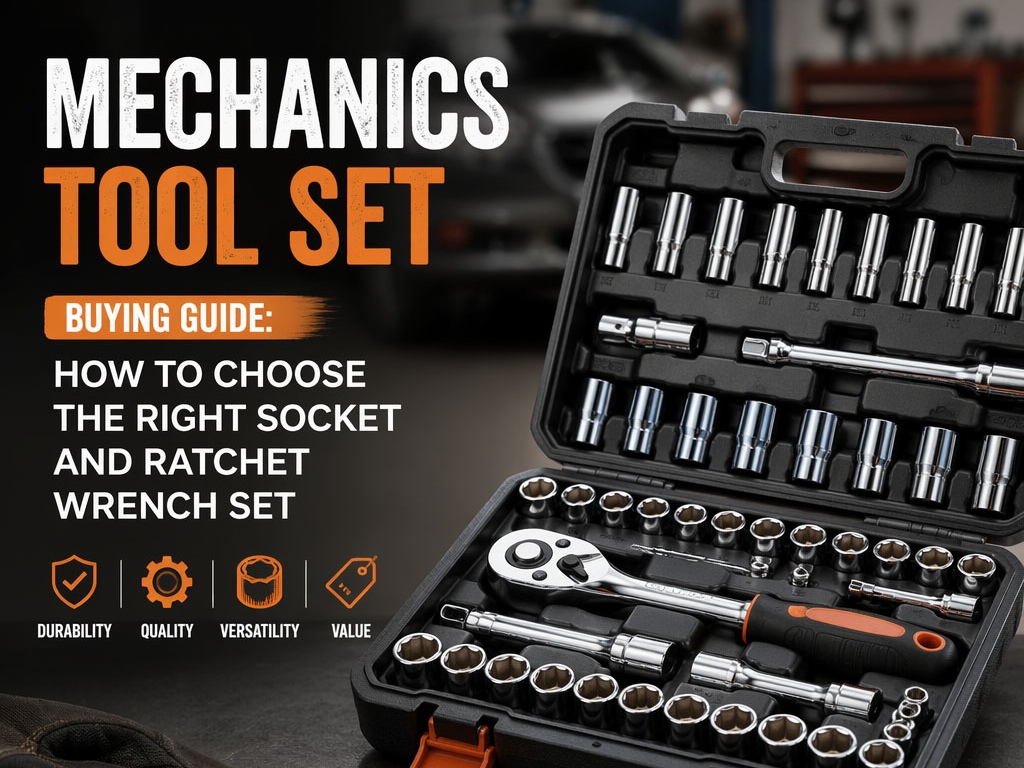
A solid mechanics tool set saves time, prevents rounded fasteners, and makes repairs feel “easy” instead of frustrating. But not all sets are built the same: some include too many filler pieces, while missing the sizes you actually need.
This guide breaks down what matters when buying a mechanic tool set, including how to choose a socket and ratchet set, when a ratchet wrench set is enough, and when you should add a ratcheting wrench set for faster work in tight spaces.
1) Mechanics tool set vs socket and ratchet set: what’s the difference?
Here’s a quick breakdown of the most common set types:
Socket and ratchet set: sockets + ratchet handle + extensions + adapters (the core of most automotive work)
Ratchet wrench set: often used to describe a socket set that includes ratchets (ratchet handles)
Ratcheting wrench set: combination wrenches with a ratcheting box end (great in tight spaces; faster than standard wrenches)
Mechanics tool set: typically includes sockets/ratchets + wrenches + bits + hex keys (sometimes pliers/screwdrivers)
If you work on vehicles regularly, a true mechanics tool set tends to be the best value—as long as it includes the right drive sizes and real-use socket sizes.
2) Choose the right drive sizes (1/4", 3/8", 1/2")
Drive size is the #1 reason a set feels “complete” or “limited”.
| Job type | Best drive size | Why it matters |
|---|---|---|
| Interior, clamps, small fasteners | 1/4" drive | Compact; better control |
| Most automotive repairs | 3/8" drive | Best all-around for cars |
| Lug nuts, suspension, higher torque | 1/2" drive | Strength + leverage |
Best practice: For a mechanic tool set, look for at least 1/4" + 3/8", and add 1/2" if you do wheels/suspension.
3) Socket types that actually matter (6-point vs 12-point, deep vs shallow)
6-point vs 12-point sockets
6-point sockets grip flats better and reduce rounding—recommended for tight or rusty fasteners.
12-point sockets are quicker to position but can slip more on stubborn bolts.
If you want one “do-it-most” option: prioritize 6-point coverage in the most-used sizes.
Deep vs shallow sockets
Deep sockets handle long studs and recessed nuts (very common in automotive).
Shallow sockets fit low-clearance spaces.
A strong socket and ratchet set includes both deep and shallow in core sizes.
4) Ratchet quality checklist (what separates cheap sets from reliable sets)
A ratchet can make or break your day. When evaluating a ratchet wrench set (ratchet handle + sockets) or a full mechanics tool set, look for:
Tooth count (swing arc)
Higher tooth count = smaller swing arc = better in tight spaces
Many users prefer 72T or 90T for automotive work
Quick-release button (faster socket changes; fewer dropped sockets)
Reversible lever (smooth, positive direction change)
Solid feel under load (skipping under torque is a red flag)
5) Ratcheting wrench set: when you need it (and why it’s not the same as a ratchet)
A ratcheting wrench set is ideal when you have limited swing room and want speed. It’s especially useful in:
Engine bays and tight brackets
Motorcycles and small machinery
Repairs where a socket can’t sit straight
What to look for in a ratcheting wrench set
Real-use sizes (metric for most modern vehicles; SAE for older/region-specific hardware)
Offset box end for knuckle clearance
Clear size markings (laser-etched or stamped)
Durable steel (commonly Cr-V) + corrosion-resistant finish
Many mechanics use sockets/ratchets for torque, then switch to ratcheting wrenches for speed.
6) Metric vs SAE: which mechanics tool set should you buy?
Metric: essential for most modern cars, motorcycles, bicycles, and imported equipment
SAE: useful for older vehicles, some American equipment, and mixed household hardware
If your budget allows, choose a mechanics tool set with both metric and SAE. If you must choose one: go metric-first for automotive in 2026.
7) “How many pieces?” Avoid filler-piece tool sets
Big piece counts can be misleading. A practical mechanic tool set should cover:
1/4" + 3/8" (and optionally 1/2") ratchets
Shallow + deep sockets in common sizes
Extensions + universal joint (U-joint)
Bit driver + common bits
A basic ratcheting wrench set (or at least standard combination wrenches)
| User | What to prioritize |
|---|---|
| Home DIY | 1/4" + 3/8", common sockets, basic extensions |
| Weekend mechanic | Add deep sockets, U-joint, better ratchet (72T/90T) |
| Regular automotive work | Add 1/2" drive + ratcheting wrenches |
8) What to avoid (common regrets)
Buying a set with tons of bits but missing deep sockets
Only having 1/4" drive (too small for many automotive bolts)
Low-quality ratchets that skip under load
Hard-to-read size markings (slows you down every job)
9) Recommended setup (replace links with your products)
If you’re looking for a reliable socket and ratchet wrench set as the foundation of a mechanics tool set, choose a kit that includes:
Drive sizes: 1/4" + 3/8" (optional 1/2")
Sockets: 6-point, shallow + deep
Ratchets: fine-tooth (e.g., 72T/90T), quick release, reversible
Wrenches: compact ratcheting wrench set for tight spaces
Storage: labeled blow-mold case
Shop: Mechanics Tool Set · Socket and Ratchet Set · Ratcheting Wrench Set
FAQ
What’s the best mechanics tool set for automotive work?
A good automotive mechanics tool set typically includes 3/8" drive as the core, plus 1/4" for small fasteners, deep sockets, extensions, and a fine-tooth ratchet for tight spaces.
Ratchet wrench set vs ratcheting wrench set—what’s the difference?
A ratchet wrench set usually refers to ratchets + sockets. A ratcheting wrench set refers to ratcheting combination wrenches. Many mechanics use both.
Are 6-point sockets better than 12-point?
For stubborn or rusty fasteners, 6-point sockets are usually better because they grip more securely and reduce rounding. 12-point can be quicker to position.
Do I need both metric and SAE sockets?
For modern vehicles, metric sockets are essential. SAE is helpful for older vehicles or mixed hardware. If you want one set to cover everything, get both.
What drive size is best for a beginner mechanic tool set?
Start with 3/8" drive as your main set, then add 1/4" for small bolts. Add 1/2" when you start doing wheels and suspension.
Keyword targets included: mechanics tool set, mechanic tool set, socket and ratchet set, socket and socket, ratchet wrench set, ratcheting wrench set.

 Customer Service